Showing posts with label real estate. Show all posts

Saturday, 17 December 2011

How did Singapore's Cooling Measures Impact Malaysia's Property Sector? (Dec 2011)

On 7th Dec 2011, the Singapore government announced that it would impose an Additional Buyer's Stamp Duty (ABSD) to moderate investment demand for private residential property and promote a more stable and sustainable market. This is needed in view of the stubbornly high inflation rate in Singapore amidst the slowing demand from developed markets. For those who don't know, inflation rate in Singapore was mainly contributed by surging property prices.


The ABSD was effective 8 Dec 2011. After the announcement, property-related stocks slumped last week, following by a slump in banking stocks because of an expected slower housing loan growth. The latest measures are a near-term negative for property developers with an anticipated trend in lower average selling prices and transactional volumes, which will hurt profitability. Nevertheless, most large-cap property developers in Singapore are relatively well diversified, not just across sectors (industrial and commercial), but also geographically.

Under the latest cooling measure, the ABSD will be added on top of the current Buyer's Stamp Duty, and apply to the purchase price or market value of the property (whichever is higher) according to the type of purchase as below:

  1. ABSD of 10% for foreigners and corporate entities buying any residential property
  2. ABSD of 3% for permanent residents who already own one property, and buying the 2nd and subsequent residential property
  3. ABSD of 3% for Singaporean citizens who already own 2 properties, and buying the 3rd and subsequent residential property.


What's the Impact on Malaysian Property Sector and Developers?
Because of our closely linked economies, some of our property players already ventured into Singapore property market, such as Sunway, SP Setia, IOI Corp and YTL Land. According to OSK research report, Sunway has 4 ongoing projects with a total GDV of around SGD1.7bn under its 30:70 joint venture with Ho Hup Group and a small wholly owned project with at GDV of SGD32.8m. Two of the projects, which are under the Executive Condo (EC) and Design, Build and Sell Scheme (DBSS), are exempted from the ABSD. While the remaining three ongoing projects, coupled with another upcoming project (GDV: SGD357m), are under private development (PD) which is subjected to the ABSD. However, with its ongoing PD projects already achieving a strong take-up rate at around 70%, we believe the impact on Sunway will be rather minimal.

Sector wise, Finance Malaysia believes that there will be a in-flowing of money to our shore given its proximity to Singapore, coupled with the attractively packaged Johor's Iskandar Development Region (IDR). This would be a timely process where IDR is gaining traction with basic infrastructures were almost completed. Those developers which had already jumping into IDR may benefits from the announcement. Tebrau Teguh, being one of the most sensitive stocks linked with IDR may see some buying interest. 


Asia property sector to deteriorate?
A combination of excess liquidity, low interest rates and a robust macroeconomic outlook has pushed prices up over the last few years. As a result, housing affordability for low and middle income families has worsened across the region, with low interest rate slightly cushioning the adverse effect of higher prices. Several central banks have intervened and introduced regulatory measures - such as higher minimum down payments (etc. Msia) and more land releases for construction (etc. Singapore) - to cool down the markets and slow credit expansion.

Within a specific market, the prime segment should hold up better than the mass-market segment. Should the real estate market correct instead, steep corrections for the mass segment are unlikely because of the following reasons:
  1. Rental Yields still appear attractive in the current low interest rate environment;
  2. Residential vacancy rates are low in many Asian cities, especially in Hong Kong and Singapore (not in the case for Msia);
  3. Governments are well aware of the potential negative spillover effects of a strong housing market downturn to the overall economy. Thus, they are more proactive in making monetary decision to juggle between tightening or loosing the monetary policies.

Wednesday, 23 November 2011

New IPO: Pavilion REIT


Are you bored of the current small market capitalization of REITs in Malaysia? I think Sunway REIT (the largest REIT right now) is by far sitting there very lonely without anyone closer to it. Come 7th December 2011, we will witnessed a new contender - Pavilion REIT, to challenge the title. Although it may started-off in 2nd place, the new REIT may grows to clinch the first place from SunREIT. Below is some info taken from RHB Research report on the IPO;


Pavilion REIT (PavREIT) has an asset size of RM3.5bn, just after the largest MREIT - Sunway REIT’s RM4.5bn. PavREIT has two assets – Pavilion KL Mall which is worth RM3.4bn and Pavilion Tower (office) RM128m.

The Prime Asset

Pavilion Mall is one of the only four premium retail malls in KL. It is designed to complement the malls along Jalan Bukit Bintang, developing the street to a key shopping destination in the region. Located at the “Golden Triangle”, which is the business, shopping, entertainment and tourism district, the mall enjoys massive catchment of population. It has an NLA of 1.33m sqf.


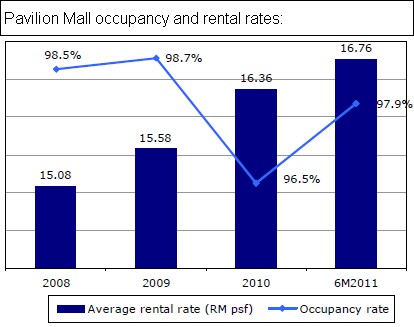
Since it commenced its operations in late 2007, occupancy has consistently stayed above 96%, with a 3-year CAGR of 4% in average rental rate. With such a short operating history, the mall has recorded 31m visits in 2010, comparable to Suria KLCC’s 40m footfalls. Over the longer term, Pavilion Mall is poised to enjoy higher number of visits as it will sit near to the upcoming MRT station, which is less than 300m away. The covered skybridge currently under construction that connects Pavilion Mall and KL Convention Centre which in turn adjoins Suria KLCC and the Petronas Twin Towers, will also pull in more shopper traffic between the two tourist spots.


The Pavilion Tower (NLA of 167k sqf) is an office tower connected to Pavilion Mall. It currently has an occupancy rate of 41.4% (expected to achieve 80% by year end), housing Malton roup, Mrail International, Clever Eagle and Aker Engineering (from 1st July). As the office tower only contributes about 2% to total rental income, coupled with the oversupply of office space in KL city centre, we are neutral on this commercial asset.

Future Growth Potential

Three other retail assets can potentially be injected in future for growth. PavREIT has been granted rights of first refusals (ROFR) by its sponsor and a 3rd party to purchase fahrenheit88, Pavilion Mall extension and an upcoming community mall in USJ Subang. These assets are estimated to have a combined value of about RM1.5-2bn. We believe the injection of assets will take 2-3 years, as only farenheit88 is still in the early stage of operation, and the other two malls will only be completed in three years’ time.


How to Value?

We benchmark PavREIT against KLCCP. Although KLCCP includes non-retail assets such as office towers and hotel apart from Suria KLCC, all these assets are of Grade A class. To reflect its prime status, we value PavREIT at a target yield of 5%, which is close to the average yield of 4.72% for KLCCP over the past 5 years (we gross up to exclude the impact of corporate tax – as REITs do not have corporate tax component). This translates to a fair value of RM1.14, based on our FY12 DPU estimate.

Source: RHB Research report


Monday, 25 April 2011

When is the BEST time to buy House? (25 Apr 2011)

Last year 2010, Malaysia property market recorded the BEST year ever. Will it be another record breaking year in 2011? Many economist and property analysts opine that this year, the property market will appreciates by another 10-15%. So, should we wait some more?

Recently, many of my friends keeps on asking the same bold questions.
  • Should I buy house now?
  • Or, should I wait some more?
  • But, when is the property downturn?
Modern Design: Swimming pool in the house.
Good questions though, but if you ask me when is the property downturn, I really do not know. As a rule of thumb, I will rely on the stock market to give me the indication. Commonly, property market will take a blow one year after the crashing of stock market. Example, the 2008 financial crisis gave us a good timing to invest in property market. For those who buy house during that time, you should know what I am talking about and smile.

So what? How about now?

Before answering your question, I would like to throw you back a question "Are you looking for your first house?". If YES, anytime is the best time to own a house, forget about the timing factor. Your objective to own it, not invest for return. Why bother waiting for the best time? Otherwise, you are renting while waiting, and money still running out of your pocket every month.

But if your answer is NO, and you treat it as an investment, I do not think this is a good time. Why? As you already know, the valuations is rich enough to swallow your future potential return. Given the risk reward profile, it is not worth to invest at current high level to exchange for a reasonable return. If you're renting it out, sure this is not wise move. Please bare in mind that the rental is very hard to go hand-in-hand. Prices are going way too fast for rental to catch up now.

Monday, 18 April 2011

Real Property Gains Tax (2011)

Malaysia is known as "tax heaven" of the world. Why? Because Malaysia does not impose tax on any capital gains derived from investment, such as shares, unit trust... But, there is only one type of capital gains that attracted tax - property.
PARC @ One South, Seri Kembangan
Real property gains tax (RPGT) is a form of capital gains tax. RPGT is charged on gains arising from the disposal of real property in Malaysia. These so called real property is defined as:
  • any land situated in Malaysia and any interest, option or other right in or over such land; or
  • shares in a real property company
How much?

Actually, we have RPGT in our tax system many years ago until 31 March 2007, when government abolished RPGT to attract foreigners to invest in Malaysia. But then, from 1 January 2010, RPGT is re-imposed at the rate of 5% on gains arising from disposals of chargeable assets in respect of real properties that are disposed within 5 years of owning.

What is real property company?
It is a controlled company holding real property or shares in another real property company as a major asset. And, the "major asset" here refers to defined value > 75% of the value of its total tangible assets.

Mon't Kiara
Withholding of RPGT
With effect from 1 January 2010, an acquirer of chargeable asset must withhold 2% of the total value of the acquisition price to be paid to the Inland Revenue Board within 60 days from the date of disposal.
Are there any exemptions?
  • an amount of RM10,000 or 10% of the chargeable gain, whichever is greater, accruing to an individual (w.e.f 1 January 2010)
  • gain arising on disposal as a result of compulsory acquisition of property under law
  • gain accruing to an individual who is a citizen or a permanent resident in respect of the disposal of one private residence
In other words, everyone of us have one "Free RPGT" card in hand. This is the ONLY card that the government gave us, and we can decide to use it or not, and when to unveil the card. You can saved it for another day, because it is not compulsory to use it for your first disposal.

Friday, 8 April 2011

Personal Income Tax 2010: Residential Property

With effective from Year of Assessment (YA) 2009, Malaysian resident who acquired any residential property are given the specially designed tax relief of up to RM10,000 a year for 3 consecutive years from the first year the interest is paid.


Residential property means a house, condominium unit, apartment or flat which is built as a dwelling house. This kind of tax relief was given by the Government to counter the property market downturn, or to spur the property mart after the 2008 global financial crisis. It has proven to be a success in Malaysia for the past 2 years, where property prices skyrocketed to a not so comfortable level for most of Malaysians. People are crying foul on the high price to own a house nowadays.

What is the Terms and Conditions?
To qualify for the tax relief, the following conditions must be met:
  • the taxpayer is a Malaysian citizen and a resident;
  • limited to one residential unit;
  • the sale and purchase agreement is signed between 10th March 2009 and 31st December 2010;
  • the individual has not derived any income in respect of that residential property
How about Joint-Ownership property?
Yes. You still will entitled for the interest expended tax relief where:
  • 2 or more individuals are eligible to claim relief for the same property; and
  • where the total interest expended by those individuals exceeds the allowable amount for that year, each individual is allowed an amount of relief for each year based on the following formula:
 
In other words, the total interest expended would be RM10,000 per house, and it can be proportionate in accordance to the number of individuals. Example, Alex and Esther purchased a house, and the finance interest incurred for that year of assessment amounts to RM30,000. Alex only pays 30% of the installments while Esther paid the remaining 70%.
So, for that YA, Alex would entitle for RM3,000 interest relief while Esther would get RM7,000. If both of them already married, and if Esther elects for joint assessment, then RM10,000 would be given to Alex.

Source: Inland Revenue Board website

Related Posts:


Wednesday, 30 March 2011

How US Housing Market fares lately? (30 March 2011)

Indeed, there is a insightful write-up by RHB Research today on the US housing market. People are still very curious about the US housing market, but yet to have the courage to BUY. Herd mentality? And, why US housing market is catching the attention of the world? Oh, thanks to Rich Dad Poor Dad, and the world famous property tycoon, Donald Trump.


In fact, I am wondering how did Donald fares these few years? That's why Donald had teamed up with Robert Kiyosaki to publish a book last year? People stop buying property because they're buying books nowadays?

A Double-Dip in the US Housing Market?... by RHB Research (30 March 2011)

US home prices, as measured by the S&P/Case-Shiller composite index of 20 metropolitan areas, declined by 0.2% mom in January vs -0.4% in December, and dipped for the 7th straight month to the lowest since April 2009. Year-on-year, home prices in 20 major cities fell by a larger magnitude of 3.1% in January, the 4th consecutive month of decline and from -2.4% in December. Home prices in these cities climbed up for 8 consecutive months from February until September 2010, before relapsing into a decline again since October last year, suggesting that the housing market is weakening, which will remain a drag to the economic recovery.

In many areas, home prices have fallen to 2003 levels, prior to the start of the housing bubble, due to the glut of supply in the housing market caused by rising foreclosures. This was compounded by potential house buyers' expectations of further drop in house prices, making them stay on the sidelines before entering the market to buy even cheaper houses. As a result, prices may fall further until foreclosures and short sales are cleared. Also, despite the millions of foreclosures and short sales, which is when lenders allow homeowners to sell for less than they owe on their mortgage, many of the homes for sale are undesirable, as the supply of homes that people actually want to purchase or could afford to is much narrower.


As a whole, falling prices and weak home sales would likely pose a drag to the economy, which is showing signs of strength elsewhere. Already, claims for unemployment benefits are at pre-recession lows, consumers are spending more money and manufacturing activity is growing at its fastest rate in 7 years. By contrast, sales of existing homes are coming off the worst year in more than a decade. And new homes are selling at the slowest pace on records dating back to 1963. In part, the weakening prices show how much a home-buying tax credit stimulated sales in late 2009 and early 2010. Once those tax credits expired in April 2010, many markets began a decline that shows no sign of stopping yet. Some economists say the tax credits merely postponed the bottoming out that's occurring now.

So, when would US Housing Market Recovers?
Finance Malaysia has a very general answer, abandoning all those complicated theories and analyst, that the US housing market will recovers once investors can't find any bargain at emerging markets. This year, Hong Kong is expecting a slowdown in property sales, with Li Ka Shing too looking to other vehicles for growth. China is going to increase interest rate again to curb excessive liquidity and inflation. Back home in Malaysia, BNM is hinting for more measures to control high household debt. Soon, investors would re-look and re-position themselves on US once emerging countries can't give them their desired return.

Thursday, 10 March 2011

My First Home Scheme: Home of Trouble Ahead?

Once again, to address the affordability issues of properties, MyFirst Home Scheme (My1st) was launched by government on 8th March 2011. Thanks for addressing the problem faced by young Malaysians working adults. But, does it really worth to even think about the scheme?

Of course, owning a house at young age is a good start to family planning. In fact, we're living in a society where buying a new house tights closely to starting a family. But, this is not necessary a MUST to everyone of us. We must do proper planning before committing for such a long-term loan with such huge amount. Buying a house is not buying an iPad or iPhone.

Only apartments are likely with less than RM220,000 price tags in Klang Valley now
Highlights of My First Home Scheme...
  • For those earning less than RM3,000 monthly
  • Working in private sector
  • Confirmed employees with a minimum of 6 months in the job
  • Joint applications are allowed (both in private sector and are family members)
  • 100% loan financing for first house purchasing
  • Eligible houses: Between RM100,000 and RM220,000
  • Both under construction or completed properties
  • Repayment period of up to 30 years
  • Monthly loan repayment must be < 1/3 of applicants' monthly gross income
  • 25 participating banks / financial institutions
Burning questions to participating banks...

  1. Does the participating banks offering the same rate as currently practiced?
  2. Does the banks really allocate sufficient funds for such loan?
  3. Would the bank perform stricter credit checks since many borrowers are young and categorized as higher risk group?
Burning questions to borrowers...
  1. Are there any houses out there you still think that is not overvalue? Still berbaloi?
  2. Assumed that you found one, does it fit into your desired picture? Safe surrounding?
  3. Assumed that you also found one, are you quick enough to snap it?
"Trouble Ahead"?
Assuming that loan rates as BLR-2.2% (BLR currently is 6.30%) and a 100% loan amount of RM220,000, the monthly loan repayment is RM1,063. If an eligible guy take the loan with maximum salary of RM3,000 allowed, the take home pay after EPF deduction was RM2,670 only. This translates into 40% of net income!

Example calculations of monthly loan repayment

Do not forget the legal fees, stamp duty, fire insurance, MRTA, cukai pintu, cukai tanah and renovations fees! I think most of our fresh graduates will buy a new car first. Assuming that the car loan installment is RM500 monthly, this would add up to 58% of net income!
To make trouble bigger, please take note of the changing interest rate environment, which means the BLR would possibly revised upward in the future. Then, your loan repayment will be adjusted higher accordingly. Can you afford your loan repayment then?

Related posts:

Monday, 17 January 2011

Latest news on SP Setia (Jan 18)

Lately, SP Setia is in full limelight in local bourse due to some of the announcements made. And, yesterday, SP Setia was awarded a contract and proposed some of the corporate exercises subsequently. Below is some of the useful summary for investors keeping abreast with the latest developments:


The Bangsar land deal
  • SP Setia was acquiring a 40-acre land along Jalan Bangsar via a land swap deal
  • Government to acquire land in Setia Alam from SP Setia
  • Develop a fully integrated health and research complex to be known as 1NIH Complex in Setia Alam under the Ministry of Health's purview
  • Redevelop the swapped land into an integrated mixed residential and commercial project and give the Government a 20% profit sharing.
Source: OSK Research

The Proposed Corporate Exercises
  • Proposed private placement of up to 15% of paid-up share capital via book-building for the following purposes:
  • - RM6bn KL EcoCity, which comprises a corporate tower block and retail podium
  • - Setia City project, which comprises a convention centre, corporate HQ and related infrastructure
  • - Fulton Lane project. A residential condominium project in Melbourne, Australia
  • Proposed 1-for-2 bonus issue after the completion of the said private placement
Source: Company, OSK Research, RHB Research

Thursday, 6 January 2011

Sunway Nexis... Connect. Work. Play

To capture the feel-good sentiment of local property market, Sunway City Bhd launched its latest integrated mixed development, Sunway Nexis, located at Dataran Sunway, Petaling Jaya. It was launched following the success of Sunway Giza, which open its doors recently.


The development is being undertaken by Sunway Damansara Sdn Bhd, with a gross development value (GDV) of RM500 million.

  • A mixed commercial development sprawling over 5.83 acres
  • Situated at the junction of Persiaran Surian and Jalan PJU 5/1A
  • Located within the main commercial hub in Dataran Sunway
  • Well serviced by a number of highways including NKVE, LDP and SPRINT
  • Modern 3 storey retail shops priced at RM4million and above
  • A 13-storey office suites block, priced more than RM 700,000 each unit
  • A 20-storey flexi office block

Source: Sunway City Bhd, Business Times

Saturday, 1 January 2011

MyFM's Jack Lim to open a Shopping Mall

Strategically located between Puchong, Seri Kembangan and Putrajaya, a new shopping mall within a park was planned to open in October 2011. Said to be first of its kind in Malaysia, the mall was dubbed as an one-stop outdoor living mart.

Popular MyFM DJ, Jack Lim (林德荣)
The Project:-
  • Undertaken by Green Atmosphere Sdn Bhd (GA)
  • Called "Garden Explore"
  • RM 20 million Gross Development Value
  • Occupying 5.9 ha of land area, which was leased from Tempo Properties Sdn Bhd for 10 years
  • Covering 7 major zones of outdoor retailing lots, a plaza and entertainment hall, offices, cafes, restaurants and one petting zoo
  • Construction will start work after Chinese New Year
The People Behind:- 
  • Radio Station MyFM's Jack Lim, director of GA
  • Former actor, Nick JM Wong, managing director of GA
  • Weng Zheng Steel Bhd chariman Tan Ching Kee, adviser
Source: Business Times, Bernama

Saturday, 11 December 2010

3 wrong perceptions on Malaysia's Properties

In Malaysia, property investment is gaining momentum since last year. And, the property sector seems unstoppable with record breaking sales. New launches are fully taken up within few hours. Speculators are becoming greedier than ever. Calming down, figuring out, is it so attractive after all? Let's have a look at the 3 big wrong perceptions


Wrong perception #1: 
Malaysia's properties still attractive?

No doubt, many analysts and researchers comment that the local market price is still low if comparing to regional markets, such as Singapore and Hong Kong. This was wrong because we cannot simply compare with islands, where land is limited. We cannot simply compare with China, where billions of people chasing for limited supply of houses.

Wrong perception #2: 
KL Developers are going high-end?

Yup… KL developers are focusing at launching those high-end residential units. But, do not come into conclusion just that. First, we must look into the locations of these new launches, especially those at golden triangle. Locations play a vital role of setting the price of properties. Second, the cost of acquiring a particular land, and the cost of constructing sure will add to the price where buyers have to bear. Third, I noticed that many super high-end units are located on hills top. Difficulties to get the relevant approvals and moving machines up there was included into the selling price of course. Though, I can't deny there are developers trying to mark-up the price, as buyers think that the costlier the better.

The Pearl @ KLCC
Wrong perception #3: 
Malaysians household debt is high because of house loan?

Generally, house loan could easily be our biggest "earning-eater". House installments eat into our monthly salary. While there is good debt and bad debt, I categorized property as good and car loan as bad debt. Malaysians high household debt is caused by the high car price, which is not worth to have if comparing with a house. And, my previous article "Proton loves Perodua to avoid extinction?" highlighted the problems of local car industry which directly affecting our daily lives.

Thursday, 2 December 2010

E&O is the next take-over target?

The recent spate of mergers have been dominating the trading sentiment of local market, with IJM-MRCB, UEM Land-Sunrise, and Sunway-SunCity. Investors are wondering whether there is any mergers activities else, and the million-dollar question is "Who is the Next".

 Main factors of taking private...
  1. Undemanding valuation
  2. Strong branding
  3. A well-run and profitable company
Quayside (Seafront Resort Condominium) of E&O property development
 After screening through the list of property counters, E&O could potentially emerged as the next company of being privatized. The main reason being E&O's is trading at a huge discount to its revised net asset value (RNAV) of RM2.72* per share.


Other than that, E&O has a very good brand name in the premium market, having some prime land-bank in strategic locations (especially in Penang). Couple with its strong marketing acumen, this company fit nicely into the take-over picture currently.

Spicing it up, speculations to privatized E&O has emerged in one of the news portal few months ago, saying that the major shareholder of E&O would made an offer for the rest of the remaining shares he did not hold.

Sunday, 7 November 2010

Why UEM Land acquires Sunrise?

About the offer…

On 4th November 2010, UEM Land Bhd plans to take control of Sunrise Bhd in a RM1.4bil deal. Shareholders of Sunrise are given 2 options:
  1. UEM Land to acquire Sunrise shares at RM2.80 via the issuance of UEM Land shares at RM2.10 each, or
  2. Sunrise shareholders get 2.80 redeemable convertible preference shares (RCPS) for every one offer share.
 

Why Sunrise?

Reasons given by UEM Land were:
  • Leveraging on Sunrise Group's robust financial strengths and prospects
  • Accelerate UEM Land's own business expansion
  • To secure new development projects
  • And, to create another Capital Land (Singapore state-own company which is one of Asia's biggest property developers)

After the deal is completed…
  • UEM Group's shareholding in UEM Land will fall to around 60%
  • Major shareholder of Sunrise will have stake of around 9% in UEM Land
  • Sunrise will be delisted from Bursa Malaysia
  • But, the brand name of Sunrise will be retained
  • Creating an enlarged group with combined asset base of over RM5bn


Finance Malaysia thinks that the acquisition would compliment UEM Land's lack of expertise in high-rise, high-end property development. What UEM Land's business was in macro township development, such as the Nusajaya project. Mont Kiara, being the award winning development by Sunrise, is a clear example. UEM Land knows that Nusajaya would NOT be perfect without a brand and expertise such as Sunrise's.


Anyway, FM doubts whether the offer will go through smoothly with a mere 11% premium being offered to Sunrise's shareholders. Moreover, Sunrise was planning to launch 4 projects with total gross development value of RM3.2bn soon.

Friday, 5 November 2010

70% Loan to Value

On 3rd November 2010, Bank Negara Malaysia wishes to announce with immediate effect the implementation of a maximum loan-to-value (LTV) ratio of 70%, which will be applicable to the 3rd house financing facility onwards taken out by a borrower.


Financing facilities for purchase of the 1st and 2nd homes are not affected and borrowers will continue to be able to obtain financing for these purchases at the present prevailing LTV level applied by individual banks based on their internal credit policies.

Why?
The measure aims to support a stable and sustainable property market, and promote the continued affordability of homes for the general public. 

At the national level, residential property prices have increased steadily in tandem with economic development and the rise in income levels.  This aggregate growth trend remains largely manageable and has not deviated from the long term trend in residential property prices.  In the more recent period, however, specific locations, particularly in and around urban centres, have experienced faster growth, both in the number of transactions and in house prices. This is further supported by an increase in financing provided for multiple unit purchases by a single borrower, suggesting increasing investment activity that is of a speculative nature.


The targeted implementation of the LTV ratio is expected to moderate the excessive investment and speculative activity in the residential property market which has resulted in higher than average price increases in such locations. This has also led to increases in house prices in surrounding locations, thus contributing to the declining overall affordability of homes for genuine house buyers.  This measure therefore remains supportive of the objective of encouraging home ownership among Malaysians which continues to be an important national agenda.

Finance Malaysia:
A conservative move by BNM, to avoid dampening the whole property market, and at the same time taking pre-cautious measure to "deflate the mini property bubble". As FM mentioned before, Government should introduce a higher Real Property Gain Tax (RPGT) which could effectively curb excessive speculation. But, such move is not popular in view of the upcoming general election which could be held as soon as first half of 2011.

FM DO NOT think that the latest movement by BNM will have any effect on the market. This is because one could buy his/her 3rd house using his/her child or spouse name instead. Maybe this is an advantage of having many children?

Source: BNM website

Saturday, 23 October 2010

5 rules of thumb on M-REIT investing

Unlike other countries, Malaysia REIT (M-REIT) has its own characteristic. Therefore, one has to master the following 5 basic rules before investing in M-REIT.

1. Management
Good asset management team will stand out from the rest, in case, there is a property bubble. There is cycle in real-estate industry, where required REIT managers to examine and act accordingly. For those experienced managers, any slowdown in real estate industry provided them the opportunities to enhance the trust portfolio.

2. Comparing dividend yield
The main purpose to invest in REIT is for its stable dividend yield. M-REIT is popular for its high dividend yield, which ranges from 7-9% currently. Of course, each REIT has its own figure due to different type of assets.

3. Choosing underlying assets
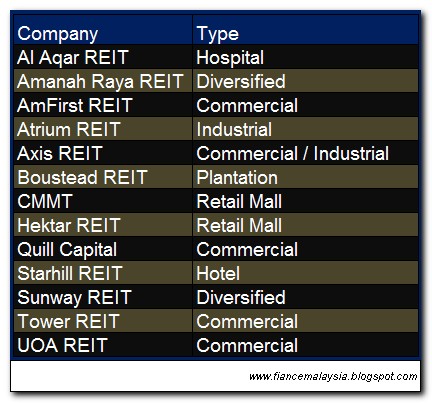
There is commercial, industrial, hotel, hospital, shopping mall and plantation REIT in Malaysia. Example, if pandemic flu occurs, hotel and shopping mall based REIT tend to under-perform, while hospital REIT will remain resilient.


4. Market capitalization
Size is the matter for Malaysia REIT, with most of them still commencing less than RM1bil market capitalization. Liquidity could pose a danger for investors to trade. Hopefully, with the emergence of SunReit and CMMT, M-REIT could become more attractive and liquid.

5. Compare with regional REITs
M-REIT tends to lag behind regional REITs, such as Singapore and Hong Kong. By tracking regional REITs, investors could predict the trend of M-REITs. This is because M-REITs are relatively young now.


Wednesday, 20 October 2010

Why China raise interest rate? And, what's the effect?

Yesterday, China surprisingly raised its interest rate by 0.25% as follows:
- 1 year lending rate from 5.31% to 5.56%
- 1 year deposit rate from 2.25% to 2.50%

Why China raise interest rate?
1. To cool down the over-heating property sector.
2. Combat inflation
3. Low liquidity in the banking system

While inflation was hovering around 3.5% currently, even though the deposit rate has been raised, the net real interest rate is still in negative territory (3.5% - 2.5% = -1.0%). This is one of the main reason why Chinese were going all out to invests, especially in real-estate, due to its low yield if sitting in the bank (even lower than Malaysia).


However, China would be facing another problem...

Raising interest rate would attract capital inflows, which could dampen the purpose of containing inflation. Foreign investors view Chinese renmimbi as undervalue, mainly due to interventions by Chinese government. The latest news could ignite a fresh round of thoughts, worsening the current situation, pushing renmimbi higher and faster.

In fact, China should target it's main problem specifically - real estate. Inflation there is mainly caused by high flying properties prices. Hence, measure such as property gain tax should be introduced first, before raising interest rate, to avoid further attracting inflow of hot-money.

Affecting Malaysia?

Given that China is one of the largest trade partner with us, Malaysia could see a surge in capital inflow also. In fact, the whole region will experience the same fate of stronger currency, making our export to western countries more expensive. Anyway, I believe that we can offset the negative effect with China being the largest commodities / resources consumer, which supplied by Asian countries.