Showing posts with label Real Estate Investment Trust. Show all posts

Wednesday, 23 November 2011

New IPO: Pavilion REIT


Are you bored of the current small market capitalization of REITs in Malaysia? I think Sunway REIT (the largest REIT right now) is by far sitting there very lonely without anyone closer to it. Come 7th December 2011, we will witnessed a new contender - Pavilion REIT, to challenge the title. Although it may started-off in 2nd place, the new REIT may grows to clinch the first place from SunREIT. Below is some info taken from RHB Research report on the IPO;


Pavilion REIT (PavREIT) has an asset size of RM3.5bn, just after the largest MREIT - Sunway REIT’s RM4.5bn. PavREIT has two assets – Pavilion KL Mall which is worth RM3.4bn and Pavilion Tower (office) RM128m.

The Prime Asset

Pavilion Mall is one of the only four premium retail malls in KL. It is designed to complement the malls along Jalan Bukit Bintang, developing the street to a key shopping destination in the region. Located at the “Golden Triangle”, which is the business, shopping, entertainment and tourism district, the mall enjoys massive catchment of population. It has an NLA of 1.33m sqf.
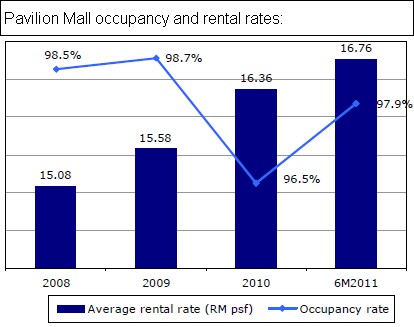

Since it commenced its operations in late 2007, occupancy has consistently stayed above 96%, with a 3-year CAGR of 4% in average rental rate. With such a short operating history, the mall has recorded 31m visits in 2010, comparable to Suria KLCC’s 40m footfalls. Over the longer term, Pavilion Mall is poised to enjoy higher number of visits as it will sit near to the upcoming MRT station, which is less than 300m away. The covered skybridge currently under construction that connects Pavilion Mall and KL Convention Centre which in turn adjoins Suria KLCC and the Petronas Twin Towers, will also pull in more shopper traffic between the two tourist spots.


The Pavilion Tower (NLA of 167k sqf) is an office tower connected to Pavilion Mall. It currently has an occupancy rate of 41.4% (expected to achieve 80% by year end), housing Malton roup, Mrail International, Clever Eagle and Aker Engineering (from 1st July). As the office tower only contributes about 2% to total rental income, coupled with the oversupply of office space in KL city centre, we are neutral on this commercial asset.

Future Growth Potential

Three other retail assets can potentially be injected in future for growth. PavREIT has been granted rights of first refusals (ROFR) by its sponsor and a 3rd party to purchase fahrenheit88, Pavilion Mall extension and an upcoming community mall in USJ Subang. These assets are estimated to have a combined value of about RM1.5-2bn. We believe the injection of assets will take 2-3 years, as only farenheit88 is still in the early stage of operation, and the other two malls will only be completed in three years’ time.


How to Value?

We benchmark PavREIT against KLCCP. Although KLCCP includes non-retail assets such as office towers and hotel apart from Suria KLCC, all these assets are of Grade A class. To reflect its prime status, we value PavREIT at a target yield of 5%, which is close to the average yield of 4.72% for KLCCP over the past 5 years (we gross up to exclude the impact of corporate tax – as REITs do not have corporate tax component). This translates to a fair value of RM1.14, based on our FY12 DPU estimate.

Source: RHB Research report


Sunday, 24 July 2011

New Fund: AmAsia Pacific REITs

Despite the current high level of share market globally, especially in Asia, there is still hanging fruits waiting for investor to grab. One of it was REITs, which lags behind its share market peers in terms of valuation. With this, AmMutual launched their latest fund which focuses on REITs investment on 18th July 2011.


The fund aims to provide regular income and to a lesser extent capital appreciation by investing in REITs. To achieve the investment objective, 70% to 98% of the fund's NAV will be invested in REITs listed in Asia Pacific region, which includes but not limited to Australia, Hong Kong, Japan, Malaysia, New Zealand, Singapore, South Korea, Taiwan and Thailand. In addition to country diversification, the Fund will also diversify into different REITs sectors such as residential, commercial and industrial. The fund will hold between 2% to 30% of its NAV in liquid assets.

Strategy Employed...
The manager employs an active allocation strategy, which means the asset allocation decisions will be made after reviewing the macroeconomic trends and REITs market outlook of the respective countries in the Asia Pacifc region. Among the criteria are:
  • track record
  • investment portfolio
  • financial status
  • income distribution policy
  • cost factors of REIT
Any distribution?
Subject to availability of income, distribution is paid at least once a year.

AmAsia Pacific REITs is suitable for investors who:
  • wish to have investment exposure through a diversified portfolio of REITs in the Asia Pacific region. Portfolio diversification is obtained by investing in REITs of various sub-sectors (for example, residential, commercial, industrial within the REITs sector) listed in various countries; and
  • seek regular income and, to a lesser extent capital appreciation over the Medium to Long Term.

Source: AmMutual and the Fund's prospectus

Saturday, 23 October 2010

5 rules of thumb on M-REIT investing

Unlike other countries, Malaysia REIT (M-REIT) has its own characteristic. Therefore, one has to master the following 5 basic rules before investing in M-REIT.

1. Management
Good asset management team will stand out from the rest, in case, there is a property bubble. There is cycle in real-estate industry, where required REIT managers to examine and act accordingly. For those experienced managers, any slowdown in real estate industry provided them the opportunities to enhance the trust portfolio.

2. Comparing dividend yield
The main purpose to invest in REIT is for its stable dividend yield. M-REIT is popular for its high dividend yield, which ranges from 7-9% currently. Of course, each REIT has its own figure due to different type of assets.

3. Choosing underlying assets
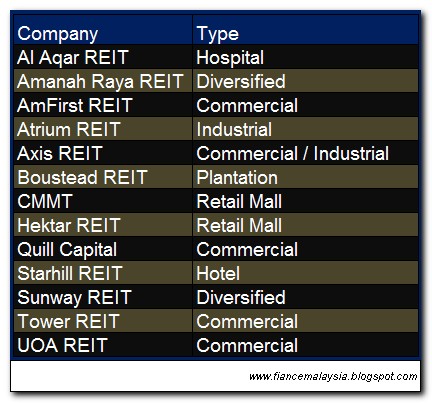
There is commercial, industrial, hotel, hospital, shopping mall and plantation REIT in Malaysia. Example, if pandemic flu occurs, hotel and shopping mall based REIT tend to under-perform, while hospital REIT will remain resilient.


4. Market capitalization
Size is the matter for Malaysia REIT, with most of them still commencing less than RM1bil market capitalization. Liquidity could pose a danger for investors to trade. Hopefully, with the emergence of SunReit and CMMT, M-REIT could become more attractive and liquid.

5. Compare with regional REITs
M-REIT tends to lag behind regional REITs, such as Singapore and Hong Kong. By tracking regional REITs, investors could predict the trend of M-REITs. This is because M-REITs are relatively young now.


Friday, 17 September 2010

Understanding REITs

What is a Real Estate Investment Trust (REIT)?
A REIT is a collective investment scheme that invests primarily in income-producing real estate assets such as shopping centers, offices, warehouses and hotels. To qualify as a REIT, a fund must have most of its assets and income tied to real estate investment and must distribute at least 90% of its total income to unit holders annually. In Malaysia, REITs are exempted from corporate tax if it distributes at least 90% of its total income.

Who is unit holders?
Every investor (like us) who invest into REITs are called unit holders, and entitled to receive income distributions (dividend).


Why invest in REITs?
REITs typically provide high income distribution (currently, 6-10% annually) plus the potential capital appreciation. Comparing 3-4% fixed deposit rate, REITs dividend yield is definitely better.

How to invest in REITs?
One can buy units in any REIT, which is listed on Bursa Malaysia, just like normal stocks trading.

Differences between REITs and Unit Trust?
Direct vs Indirect investment. Almost the same.

How often REITs makes an income distribution?
It depends on respective REITs, usually semi-annually or quarterly.

What is the Tax treatment of unit holders?
Withholding tax will be deducted for distributions made to the following categories:

Risks involved in Malaysia REIT...
- Low liquidity
- Unfavorable interest rate environment
- Deflation and Devaluation of assets

Finance Malaysia's view:
Generally, REIT is suitable for everyone (young, experienced, rich, resourceful, professional...) because it is an hassle-free exposure to real estate investment. Finance Malaysia hopes that more players will join the REIT bandwagon in Malaysia, such as IGB (Mid Valley City), IOI Corp, and even AEON's Jaya Jusco.

Coming next...
- More on M-REIT
- 5 rules of thumb on MREIT investing