Showing posts with label Banks. Show all posts

Monday, 22 July 2013

A Guide To Home Loan Refinancing

For those who have never been exposed to the concept of “refinancing”, home loan refinancing may seem like a baffling notion.  After all, what good could possibly come from getting a new home loan… just to pay off your old one? Wouldn't you just go back to square one after the whole process? These could be some of the questions you’re asking yourselves, and understandably so.


In reality, home loan refinancing is a widely-adopted practice with many potential benefits. Home buyers far and wide undertake it in order to lower the interest they’re paying on their home loans, reduce their monthly loan repayment amounts, and generally alter their loan terms to better suit their financial needs.  In fact, some even refinance to free up cash riding on the inherent values of their properties!


Want to refinance your home loan in Malaysia?
Click here to compare different rates by different banks.
Courtesy of: iMoney.my

Friday, 19 July 2013

[Property] 3 Critical Factors to Watch Out by Year End (July 2013)

Ever since the property boom started in 2009, right after the global financial crisis, investors were laughing to the bank. But, can these sustain until next year? Many analysts doubt so. Why?


The most crucial determining factors might uncover itself in the next few months, approaching year end. In short, we have summed out to the below 3 critical factors:
  1. Banning of DIBS
    This is not a secret anymore. Speculation rife up recently, saying that BNM may ban the Developer Interest Bearing Scheme (DIBS) by year end. BNM is studying the implications of DIBS which benefiting speculators more than serious buyers. Note: Singapore already banned such scheme few years back.

  2. Interest Rate hike
    BNM also may revised the Overnight Policy Rate (OPR), which determine the cost of financing in the country including Base Lending Rate (BLR) for mortgage loan. A 25 basis points hike was expected. This will affect all type of loans, except fixed interest loans. Let's get prepare for higher monthly loan installment amount.

  3. Higher RPGT
    Coming this 2014 budget to be tabled on 25th Oct, watch out for higher Real Property Gain Tax (RPGT). Currently, it was 15% for first two years and 10% for disposal from 3rd year to 5th year. Note: RPGT was much higher before 2008.


In our view, once DIBS was banned, developer no need to bear the interest, financier no need to bear the risk, new launching properties should be selling at lower price. Then, this is bad news for existing property, especially bought under DIBS before?


Example, phase one selling at RM500k under DIBS, phase two selling at RM500k without DIBS. No effect?


Think again... More supply now releasing for secondary market, assuming phase two also selling at same price, which is very good already. Right?


Friday, 5 July 2013

Latest BNM measures to Curb Excessive Household Debt (July 2013)

Hot from oven. Bank Negara Malaysia (BNM) today announce some measures to address the alarming household debt among Malaysians. As reported, household debts have continued to increase at a strong pace, averaging at an annual rate of 12% over past 5 years. While this has been supported by positive income and employment conditions, in the more recent period, there has been a growing trend in the offering of financial products that are not in the long-term interest of consumers.


What does this mean?
This includes extended financing tenures of up to 45 years for house financing and 25 years for personal financing!!! Wow... Is it too long the tenure? While this may reduce the monthly repayments, in the long run, this increase the overall debt burden of households. If we don't stop this kind of practice, it will encourage excessive debt accumulation by households and increase the vulnerability of this sector.

Hence, BNM has to take actions...
The implementation of a set of measures aimed at avoiding excessive household indebtedness and to reinforce responsible lending practices by key credit providers. These measures, which take effect immediately, complements the earlier measures introduced since 2010 to promote a sound and sustainable household sector.


What are the measures?
  1. Maximum tenure of 10 years for financing extended for personal use;
  2. Maximum tenure of 35 years for financing granted for the purchase of residential and non-residential properties;
  3. Prohibition on the offering of pre-approved personal financing products.


Who will be affected the most?
For sure, borrowers (excessive one) will be short-handed. However, those good quality borrowers will not be affected. Meanwhile, the hands of financial institutions once again being tighten further. It will definitely impact the loans growth, but with a more quality growth. Property sector will face some minimal impacts, given most of the loan approved is within 35 years of financing.


For Finance Malaysia, this is good news for our country's financial sector. Excessive household debts, coupled with poor quality loans, will endangers the financial system. Worth to highlight here is the pre-approved loan is being banned now. Long time ago, Finance Malaysia is very uncomfortable with such offerings, with the intention to "indulge" bank clients to borrow. Now, we are relieve. Do you agree?

Friday, 7 September 2012

RHBRI 4Q12 Market Strategy: Stay Defensive And Buy On Dips To Outperform The Market

Given the persistent headwinds from the external sector and general election overhang on the home front, we are of the view that the market will likely be stuck in a range-bound trading pattern in the 4Q. Consequently, we believe investors would still need to accumulate fundamentally-robust stocks on weakness in order to outperform the market, while staying defensive on the core holdings will provide greater stability to the portfolio performance.
In addition, as the search for yield will likely remain a key driver for both retail and institutional investors in the 4Q, high divided-yielding stocks will also continue to outperform the market, in our view. A list of our top picks is reflected in table below, which includes “buy on weakness” tactical stocks.


Which Sector to look at?
Sector-wise, our key overweights are telecommunications and banking, although we also have an overweight stance on the consumer, utilities, gaming and rubber gloves under the healthcare sector (see table below). We expect the high-yielding telecommunications stocks to remain relatively defensive for equity investors under the current market environment.


The banking sector, on the other hand, carries a 34.7% weighting in the bellwether index and, in our view, cannot be ignored, given the better-than-expected recovery in earnings momentum over the last two consecutive quarters. The year-to-date annualized loan growth stood at 11.9%, ahead of our and the consensus forecasts of 10-11% and 8-9% and the pipeline of corporate deals remains healthy. This suggests that banking earnings could continue to surpass expectations in the quarters ahead, which coupled with decent valuations and dividend yields vis-a-vis the FBM KLCI benchmark, would bode well for share price performance in the 4Q, in our view.

Source: RHBRI research report

Monday, 26 March 2012

All you need to know about DORMANT account

In general, banks define dormant account (sometimes referred as inactive) when an account does not have any transaction (deposit or withdrawal) for a continuous period of at least 12 months. When your account becomes dormant, the bank would send you a notice letter to the registered mailing address to remind you to activate your account. You may be required to withdrawal or deposit some money over the counter to re-activate your account.

What are the charges?

In addition, should your account balances be RM10 or less, the bank would also inform you of its intention to close the account. The bank will send you a 2nd reminder when it does not receive any response from you (i.e. for activation of account or objection to the closure) within 3 months after the 1st notice. If there is still no response after 2 notices, the bank may proceed to close the account and absorb the balances as service fee.

For account with balances of more than RM10, the account will usually be charged with a dormant account service fee typically at RM10 per annum, until the balances are exhausted or up to 7 years whichever is earlier. Please refer to the tables below on fees and charges imposed by major banks in Malaysia on Saving account.


Unclaimed moneys
When your account remains dormant for a period of 7 years, the account will be classified as unclaimed moneys. Under the Unclaimed Moneys Act (1965), the balances will be transferred to the Government. You may recover your unclaimed moneys from the Registrar of Unclaimed Moneys by submitting form UMA-7 and the required supporting documents at any Registrar offices nationwide. There is no time limit for you to claim your money back.

Contact details of the Registrar are as follows:


Pendaftar Wang Tidak Dituntut
Jabatan Akauntan Negara Malaysia

Bahagian Pengurusan Amanah dan Sekuriti
Menara Maybank, 100 Jalan Tun Perak,

50050 Kuala Lumpur
Tel : 03-2034 1850
Website : www.anm.gov.my

Source: Banking Info

Tuesday, 14 February 2012

Higher Credit Card Financing Rates Effective March 2012

Attention to all credit card holders (especially for the following mentioned banks), interest rates for outstanding credit card balances, and late payments will be revised higher. At least 3 banks, namely Hong Leong Bank, Ambank and Citibank already published the rate revision effective March 2012 on respective website.


What did Bank Negara Malaysia (BNM) said?
According to The Star Newspaper, a spokesman from BNM said the repricing of rates was not due to directive from the central bank, explaining that it was done by the banks. "However, the new rates are withing the range stipulated in Bank Negara's credit card guidelines," he told The Star.

Rationale behind the revision

Beautifully, banks said the revision was done to promote sound financial management by saying that the move would encourage card holders with outstanding debts to pay them off. But, what we understand is that for those who are in debt right now, they were being slapped with a higher finance charges plus late payments charges. Meaning, they are being drown from river to sea, pushing them into deeper debt. Is this called sound financial management?


Perhaps, YES, it is a very sound risk management for banks, definitely not card holders. Why banks revise the rates now? Well, we guess that banks are foreseeing a tighter money supply and potential deteriorating quality of loans amid the ongoing European Debt crisis. They have their strong point though.


FAQ
If I am a new card holder, what is the financed rate applied to me?
The highest finance charges will be applied (etc 18% p.a for Hong Leong Bank). The applicable tiered finance charges will only be effective until such time when you have the minimum 12 months repayment record with the bank.

Monday, 30 January 2012

BNM Further Liberalisation on Forex (Jan 2012)

As part of continuous efforts by Bank Negara Malaysia to enhance competitiveness in the economy and to develop the domestic financial markets, Bank Negara Malaysia wishes to announce the following liberalisation measures, with effect from 31 January 2012:


  1. To further spur the domestic foreign exchange market through greater product innovation, licensed onshore banks are permitted to trade foreign currency against another foreign currency with a resident.
  2. To further deepen the domestic interest rate derivatives market, a licensed onshore bank is allowed to offer ringgit-denominated interest rate derivatives to a non-bank non-resident.
  3. Towards enhancing the asset liability management of residents, flexibility is permitted for a resident to convert their existing ringgit or foreign currency debt obligation into a debt obligation of another foreign currency.


The above measures which are in line with the broad thrust of the Financial Sector Blueprint will contribute towards increasing the liquidity, depth and participation of wider range of players in the domestic financial markets.


Frequently Asked Questions:


  1. Can a resident buy and sell foreign currency against another foreign currency for any purpose?
    • Yes. With this liberalisation, a resident is allowed to buy and sell foreign currency against another foreign currency for any purpose including for trading. However, such transactions shall only be undertaken with a licensed onshore bank.
  2. Does the liberalisation include trading of foreign currency against ringgit?
    • No. The liberalisation is only for transactions involving foreign currency against another foreign currency for any purpose.
  3. What are the prevailing rules on investment in foreign currency assets?
  4. Who are the licensed onshore banks?
    • licensed commercial banks in Malaysia;
    • licensed Islamic banks in Malaysia; and
    • licensed investment banks in Malaysia.
  5. What are the prevailing rules on foreign currency credit facilities obtained by a resident?


For further information and enquiries on the measures, members of the public may contact Bank Negara Malaysia via Toll free line : 1 300 88 5465 (BNMTELELINK)

Source: BNM website

Wednesday, 21 December 2011

Malaysia Financial Sector Blueprint 2011 - 2020


Bank Negara Malaysia today released the new Financial Sector Blueprint. Themed "Strengthening Our Future", the Blueprint charts the future direction of the financial system over the next ten years.

The growth of the financial system should be ultimately anchored to the growth in the real sector. Based on the rate of growth of the economy projected for the next decade, the financial sector is envisaged to expand to six times of GDP in 2020 from 4.3 times of GDP currently. Meanwhile, the contribution of the financial services sector to nominal GDP is expected to grow from 8.6% of nominal GDP to between 10 and 12% by 2020. 


Recognising the increasingly complex linkages, both between the various components of the financial system and the greater international connectivity and regional financial integration, the Blueprint moves away from the sector-based approach of the previous Financial Sector Masterplan (FSMP).


There are 9 focus areas under the Blueprint to further advance financial sector development to drive Malaysia's transition to a high value-added, high-income economy with adequate safeguards to preserve financial stability:


  • Effective intermediation for a high value-added and high-income economy - This entails the mobilisation of diverse savings to productive investments in Malaysia and to meet the needs of both businesses and households. A vibrant risk-capital ecosystem to support innovation-driven economic activities and start-up ventures will be developed. The initiatives will also include enhancing the provision of large and long-term project financing for infrastructure development.

    To cater to Malaysia's growing affluent segment and maturing population, emphasis will be placed on enhancing the provision of financial services for wealth management, retirement and long-term healthcare. The development of a vibrant private pension industry is also expected to enhance the role of pension funds as a key source of funding for the longer-term and risk-based financing needs of the economy.

  • Developing deep and dynamic financial markets - Efforts will be directed towards improving the liquidity, depth and participation in the money, foreign exchange and government securities markets in Malaysia, in enabling more effective intermediation, transfer of risks and management of liquidity, and meeting the diverse needs of a more developed and internationally integrated economy.

    The foreign exchange administration rules will be progressively liberalised to further raise efficiency in financial market transactions. The development of vibrant domestic foreign exchange and money markets, and ensuring sound risk management and corporate governance practices by financial market players, will be an important agenda in the development of our financial system.

  • Financial inclusion for greater shared prosperity - The aim is to enable all members of society, including the underserved, to have access to and usage of quality, affordable and essential financial services. Initiatives will focus on developing more innovative delivery channels such as agent banking to enhance the outreach of financial services in a cost-efficient manner and expansion of the range of products and services such as more flexible micro financing products, long-term contractual micro saving products, and microinsurance and microtakaful products to cater to distinct financial needs of all segments of society.

  • Strengthening regional and international financial integration - As the Malaysian financial sector assumes a larger role in mobilising regional and cross-border funds and supporting the needs of both Malaysian corporations expanding abroad and corporations that invest in Malaysia, efforts to strengthen Malaysia's international financial linkages will be pursued.

    Moving forward, Malaysia's investment policy will be guided by two key considerations - (i) prudential criteria and (ii) the best interest of Malaysia criteria, which includes the effect of the investment on Malaysia's economic activity, particularly in catalysing new high value-added activities, contribution towards enhancing international trade and investment linkages and impact on financial stability, including the level of competition. A further consideration in assessing the best interest of Malaysia is the continued presence of strong and well-managed domestic banking groups that continue to mobilise a significant share of resident deposits, as this is important for the orderly growth and development of the financial sector. 

  • Internationalisation of Islamic finance - While Malaysia has made significant inroads in becoming an international Islamic financial centre, efforts will continue to be undertaken to enhance the Islamic financial ecosystem. This will entail developing a more conducive environment for the mobilisation of higher volumes of international Islamic financial flows from a diverse range of players to be channelled through innovative Islamic financial instruments. In strengthening the legal and Shariah frameworks and further advancing Malaysia's thought leadership in Islamic finance, a single legislated body to be the apex authority on Shariah matters in Islamic finance will be established. 

  • Regulatory and supervisory regime to safeguard the stability of the financial system - A comprehensive legislative framework will be enacted to reinforce a sound, transparent and accountable system for effective regulation and supervision. Focus will also be accorded towards enhancing capital and liquidity standards of financial institutions in line with international standards as well as raising their governance and risk management standards. As the financial sector grows to be more regionally-and internationally-connected, greater cross-border collaboration will be pursued with other supervisory authorities.

  • Electronic payments for greater economic efficiency - Accelerating the migration to electronic payments (e-payments) will be emphasized. In the next ten years, the Bank targets to increase the number of e-payment transactions per capita from 44 transactions to 200 transactions, and reduce cheques by more than half from 207 million to 100 million per year. Measures to achieve this aim will include providing the right price signals to encourage the switch from paper-based payments to e-payments, and facilitating wider outreach of e-payments infrastructure, such as point-of-sale terminals and mobile phone banking.

  • Empowering consumers - A comprehensive and holistic approach towards consumer protection and education will be pursued in collaboration with various stakeholders. The aim is to promote a culture of mutual responsibility shared between consumers, who are empowered with the knowledge, skills and financial literacy to manage their personal wealth, and financial service providers, who uphold fair and responsible dealings in the conduct of their business.

    The infrastructure to support greater consumer empowerment will be strengthened through establishing a single consumer credit legislation, integrated dispute resolution system and an enhanced credit information framework. Measures to promote financial capability among consumers through the integration of financial curriculum at schools and targeted financial literacy programmes based on life events will be pursued. 

  • Talent development to support a more dynamic financial sector - A Financial Services Talent Council will be established to drive, oversee and coordinate talent development efforts in the financial sector. Other initiatives include developing talent for entry level, promoting continuous learning for the existing workforce, and attracting talent from abroad. Ensuring an adequate supply of skilled talent to meet the challenges in the new financial landscape will require greater collaboration and coordination among various agencies beyond the financial sector.


The Blueprint charts a vision and direction for the Malaysian financial sector for  the next ten years that will support Malaysia's long-term ambitions. To ensure the achievement of the desired outcomes, a robust implementation and monitoring framework will be put in place, including update on the progress of the implementation of the Blueprint.


Source: Bank Negara Malaysia

Monday, 5 December 2011

The end of Europe’s liquidity crisis? (Dec 2011)

Well, many people already bored with the on-going Europe debt crisis, and subsequently liquidity crisis. This is like what we have seen in 2008 when Lehman Brothers collapses, which drags down the whole financial systems globally through liquidity crisis. The different is between company and country. Maybe some of us doesn't know how this chain effects rattles the global markets. So, let us start here.

The European Organisation chart of Debts
The root of the problem plaguing the market right now is Europe debt crisis, where Greece and few other European countries were highly in debts. They just simply cannot generate enough revenue (taxes) to support the economy itself. So, they resorted to seek for funding via borrowing by issuing sovereign bonds to finance their day to day operations. However, the debt is piling up intensively after 2008 global financial crisis until recently. Because the government does not have money, their bonds may go into default. So, they were forced to borrow some more, but with higher interest this round.

For them, this kind of measures are simply to prolong the problems and those debts were still there charging higher and higher interest. They are buying time, hoping their economies will survive and growing in the future to repay back whatever they borrow now. What a pretty picture?

Who is the main borrower?
Congratulations, the winners go to French banks. They are the main source of funding for these troubled ladden countries. As long as these banks charges those countries interests, everything is good for banks but bad for countries. What if those countries really go bankrupt? French banks may follow suits too.

So, the pretty solution is to write-off from the book of borrowers (French banks). Why French banks still need to accept the offer? Depending on the % of write-off, banks at least got something better than nothing. Right?


How the liquidity problem set in?
Debt writing-down means that the assets of French banks were being slashed. Last month, there is a 50% hair-cut for Greek debts and the amount will reflects in the books of these banks in the next few quarters. Now, you know why rating agencies are cutting 15 European banks' rating last week?

Sigh... But, not yet ends?
After the hair-cut, banks may having liquidity issues next. They doesn't have enough capital to borrow and this may dampened the whole financial system, thus, businesses and public facing difficulties to finance their expansion or consumption. Don't worry, angels were always by our side.

Angels (not Santa) come before Xmas...
Last week, 6 central banks globally take an important step toward dealing with the problems in Europe by pledging to continue provide funding to global banks (especially European banks). These angels are US Federal Reserve, the Bank of Canada, the Bank of England, the Bank of Japan, the European Central Bank, and the Swiss National Bank. They would lower the pricing on US dollar liquidity swap arrangements effectively easing the liquidity problems faced by European banks.


This action dissolves one of the stumbling blocks in global financial system. Risk plays a role when one bank lends to another. In the current environment, banks likely don't believe that they are being compensated enough for the risks they face by lending out. With the dollar swap lines, banks can instead go to their central banks for short-term loans, provided that they have good collateral. Win-win situations? Yup. I think so because one can solve the liquidity problem, while US successfully creates a huge demand for its sliding currency.

Saturday, 19 November 2011

Property prices to Come Down after BNM's latest guidelines? (Nov 2011)

Like it or not, Bank Negara Malaysia announced that effective 1 Jan 2012, financial institutions must make appropriate enquiries into a prospective borrower's income after statutory eductions for tax and EPF, and consider all debt obligations, in assessing affordability.

Aimed at promoting prudent, responsible and transparent retail financing practices, the new guidelines require financial institutions to make assessments of a borrower's ability to afford financing facilities based on a prudent debt service ratio as inputs to their credit decisions.


On top of that, a new guideline was stipulated that the maximum tenure for vehicle financing should not exceed 9 years, with immediate effect (18 November 2011). Right now, there are only 2 banks which offers vehicle financing up to 11 years, and less than 2% of car buyers now opted for tenures beyond 9 years. The changes was neglect-able.

Are you an Informed Borrower?
The guidelines additionally hope to ensure that consumers are treated fairly in the sales, marketing and administration of financing facilities. As such, financial institutions are required to provide consumers with specific information on the following:

  • total repayment amount
  • total interest cost as well
  • impact of an increase in the financing rate

The BIGgest Impact will be on Property sector?
Since that the banks are required to assess the affordability of borrowers based on net income, many people may not have the capital needed to pay for down payment. Although automobile industry will be affected, the biggest victim will be on property sector. This is because property purchasing needs more capital outlay.

On top of that, the value of property went up so high currently where the market value does not match the seller's asking price. To meet the short-fall, buyers are forced to fill-in with cash. This had already slowing down property prices lately. But, after the new guideline, would it be worst? Definitely.

The numbers of affordable buyers will became lesser. Hence, demand for property will be softened. What if supply more than demand? Simple economic theory told us that prices have to come down in order to strike a balance. I think this is true and will materialize next year.

Thursday, 23 June 2011

Why Maybank and CIMB gave up on RHBCap? (23 June 2011)

Merely less than one month of battle (not even pulling off the gun), both Maybank and CIMB today respectively announcing to abort the merger talks with RHBCap. Funny oh? First, the news of aborting was first reported by a Singapore newspaper, not Malaysia, and why not Malaysia? Second, both contenders had set end of June's proposals, announced just only last week. So fast change mind?

Both CIMB and Maybank are turning their heads away from RHB now.
Of course, between the dates, Abu Dhabi Commercial Bank (ADCB) made a significant headline when it sells its 25% stake in RHBCap to its sister company, Aabar Investment, for RM10.80 per share, which value RHBCap at 2.25 times RHBCap book value. Does this really affecting the merger talks?

What CIMB says?

In a statement Thursday, June 23, CIMB group chief executive Datuk Seri Nazir Razak said that based on its discussions and assessment of the present expectations of key stakeholders, the bank did not believe that it would be able to arrive at a value creating merger.


“Merger negotiations are both resource consuming and distracting for staff and stakeholders.


"Therefore, we prefer not to prolong our discussions unnecessarily, allowing all parties to return to ‘business as usual’ as soon as possible,” he said. (TheEdge)

What Maybank says?
“In light of recent developments and following further deliberations, the board of directors of Maybank has decided not to pursue the possible merger at this juncture,” Maybank said on Thursday, June 23. (TheEdge)

Who knows? RHB's investors should sell their holdings above RM10 previously.
What Finance Malaysia says?
"The merger talks most probably is still on-going, but behind the board room. ADCB's RM10.80 did set a hindrance for both parties to proceed with the merger talks, in order to convince other shareholders."

"Other than that, EPF's role is crucial for all parties to consider now. Sooner or later, EPF must divest its stake to below 20%. By then only can EPF remove itself from the day-to-day operations of RHB Bank. Remember, EPF's role was supposed to invest, not managing a company."

"Thirdly, Maybank and CIMB may think that the merger talks would takes a long time to consider, and it may affects the day-to-day operations of RHB Bank. Just like EONCap, many of their staffs are turning to other banks while Hong Leong Bank is launching and fighting its merger plans."

Friday, 1 April 2011

OSK Stock Picks for April 2011

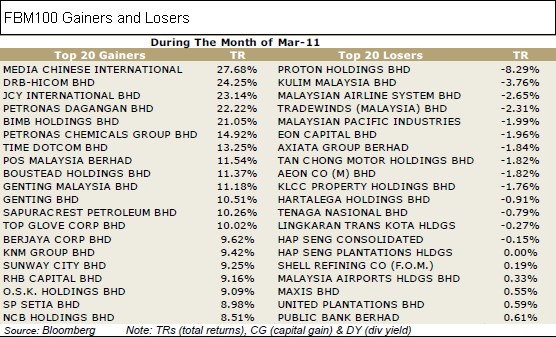
After being hit by a few Black Swan events, markets rebounded in March with the KLCI ending 1Q in the black. Moving into 2Q, we still see some short term volatility but are confident of an eventual rally to close in on our year-end KLCI target of 1680 points. We advise investors BUY Big Caps on potential rebounds while focusing on the more defensive Small Caps given their superior performance over the past few months. The favorite sectors remain Banks, O&G, Property and Construction in the mid-to-short term while the longer term buys are Media and Healthcare. This strategy is reflected in our April top buys as well.


Timber the BIG winner...
For March, timber stocks were actually the big winners, including names such as Suber Tiasa, Jaya Tiasa, TaAnn, WTK and Lingui, on hopes for better timber demand in view of reconstruction efforts in Japan. Nonetheless, these counters are not part of the FBM100. Instead, among the FBM100 constituents, media player Media Chinese and Petronas companies Petronas Dagangan and Chemicals were the big winners. Sectoral wise, O&G led the way followed by Technology (JCY), Media (MCIL), and Gaming (Genting).


Outlook: Moving into 2Q
Moving into 2Q, we see the possibility of some short-term volatility for the remainder of 2011 but market fundamentals remain sound. We maintain our year-end KLCI target of 1680 points based on an average of the 2011 KLCI fair value (1648 points 16x PER) and 2012 KLCI fair value (1710 points 15x PER). With this in mind, we maintain Overweight on the Malaysian market. Our view is driven by 4 key factors:
  • The economy will continue to grow
  • Upside and Downside are fairly equal
  • News flow ahead of the General Election remains very supportive
  • Earnings should match expectations


For April - A month of 2 Halves
We believe that there may well be 2 distinct halves in the month of April. The first half should be positive for the market, with the one of the key factors being the Invest Malaysia conference which will be held on 12 April. Among the announcements could be:
  • The disposal of Khazanah's stake in Pos Malaysia
  • The next Risk Service Contract for marginal oil fields
  • Release of Government lands for property development
However, for the second half of the month, we are concerned of greater market volatility, due to potentially less positive outcome of the Sarawak elections. Since BN already holding more than 80% of the state seats, we believe the risk is that their performance may drop in this upcoming election. Consequently, this may spark some knee jerk selling until the 1Q2011 reporting season.


Source: OSK Reseach Report

Thursday, 10 March 2011

What is Statutory Reserve Requirement (SRR)?

Everyone is buzzing about SRR lately, since Bank Negara Malaysia's statement which stated its intention to raise SRR in the near future. Actually, what is SRR? And, what is the effect of higher SRR imposed? Why BNM using SRR right now? Finance Malaysia hopes to clear everyone's doubt and would appreciate if you can share this out.


What is SRR?
Statury Reserve Requirement is a monetary policy instrument available to Bank Negara Malaysia (BNM) for the purposes of liquidity management. Effectively, banking institutions namely commercial banks, merchant/investment banks and Islamic banks are required to maintain balances in their Statutory Reserve Accounts (SRA) equivalent to a certain proportion of their eligible liabilities (EL), this proportion being the SRR rate.

Why BNM uses the SRR as its "tool"?
Since SRR is available to BNM to manage liquidity and hence credit creation in the banking system, it was used to withdraw or inject liquidity when the excess or lack of liquidity in the banking system is perceived to be large and long-term in nature. Currently, BNM believes that our banking system is lack of liquidity, thus it may raised the SRR to "store" more money in banks.

Effective 1 March 2009, the SRR rate for banking institutions is 1% of EL. As of 1st September 2007, the EL base consists of ringgit denominated deposits and non-deposit liabilities, net of interbank assets and placements with BNM.

Previous adjustments to the SRR rate
What is the effect of higher SRR?
As explained above, higher SRR means that banks in Malaysia will have to keep more money as their reserve. This translates into lower loans growth for banks. Normally, banks wiould imposed stricter loan approvals for borrowers, because less funds are available for lending.

Normally, higher SRR translates into lower profit growth for banks. Banking stocks are the hardest hit. But, raising the SRR from a record low of 1% is unlikely to have any significant impact on credit growth. Finance Malaysia see this as an opportunity to accumulates banking stocks if they are battered down because of higher SRR.

Source: OSK Research

Source: OSK Research


Source: OSK Research

Source: OSK Research

Source: Bank Negara Malaysia


Related Posts:

My First Home Scheme: Home of Trouble Ahead?

Once again, to address the affordability issues of properties, MyFirst Home Scheme (My1st) was launched by government on 8th March 2011. Thanks for addressing the problem faced by young Malaysians working adults. But, does it really worth to even think about the scheme?

Of course, owning a house at young age is a good start to family planning. In fact, we're living in a society where buying a new house tights closely to starting a family. But, this is not necessary a MUST to everyone of us. We must do proper planning before committing for such a long-term loan with such huge amount. Buying a house is not buying an iPad or iPhone.

Only apartments are likely with less than RM220,000 price tags in Klang Valley now
Highlights of My First Home Scheme...
  • For those earning less than RM3,000 monthly
  • Working in private sector
  • Confirmed employees with a minimum of 6 months in the job
  • Joint applications are allowed (both in private sector and are family members)
  • 100% loan financing for first house purchasing
  • Eligible houses: Between RM100,000 and RM220,000
  • Both under construction or completed properties
  • Repayment period of up to 30 years
  • Monthly loan repayment must be < 1/3 of applicants' monthly gross income
  • 25 participating banks / financial institutions
Burning questions to participating banks...

  1. Does the participating banks offering the same rate as currently practiced?
  2. Does the banks really allocate sufficient funds for such loan?
  3. Would the bank perform stricter credit checks since many borrowers are young and categorized as higher risk group?
Burning questions to borrowers...
  1. Are there any houses out there you still think that is not overvalue? Still berbaloi?
  2. Assumed that you found one, does it fit into your desired picture? Safe surrounding?
  3. Assumed that you also found one, are you quick enough to snap it?
"Trouble Ahead"?
Assuming that loan rates as BLR-2.2% (BLR currently is 6.30%) and a 100% loan amount of RM220,000, the monthly loan repayment is RM1,063. If an eligible guy take the loan with maximum salary of RM3,000 allowed, the take home pay after EPF deduction was RM2,670 only. This translates into 40% of net income!

Example calculations of monthly loan repayment

Do not forget the legal fees, stamp duty, fire insurance, MRTA, cukai pintu, cukai tanah and renovations fees! I think most of our fresh graduates will buy a new car first. Assuming that the car loan installment is RM500 monthly, this would add up to 58% of net income!
To make trouble bigger, please take note of the changing interest rate environment, which means the BLR would possibly revised upward in the future. Then, your loan repayment will be adjusted higher accordingly. Can you afford your loan repayment then?

Related posts:

Thursday, 27 January 2011

Extractions from BNM monetary policy statement

As expected, Bank Negara Malaysia (BNM) decided to maintain the Overnight Policy Rate (OPR) at 2.75% yesterday. This was the 3rd time in a row that BNM left it unchanged. Are there any hints by BNM on Malaysia's economy this year? We can explore the "hidden messages" from the monetary policy statement as below:


Regional Front:
  • While advanced economies continue to register modest growth, most emerging economies have experienced strong growth.
  • For Asian region, domestic economic activity continues to support the growth momentum amid weaker external demand.
  • Shifts in global liquidity have resulted in significant capital flows into the emerging economies, in particular, Asian region, and have brought with it risks to macroeconomic and financial stability.
  • The region is also being affected by global inflationary pressure arising from the higher commodity and food prices.
On Malaysia:
  • Recent indicators point towards a sustained expansion in private sector activity.
  • External demand, however, was affected by the slower global growth.
  • Malaysian economy is expected to grow at a steady pace in 2011, underpinned by continue firm expansion in domestic demand.
  • Private consumption will be supported by sustained employment and income growth.
  • Private investment activity will be supported by domestic-oriented sectors and the expansion of new growth industries.
 On Inflation:
  • Domestic headline inflation rose towards the end of 2010 albeit remained low at 2.2%.
  • The increased was mainly on account of higher food and energy prices.
  • Prices are expected to increase at a modest pace in the coming months, driven primarily by rising global commodity and food prices.
  • The assessment is that inflation will continue to be driven by supply factors with limited evidence of excess demand exerting pressure on prices.

BNM Conclusions:
  • BNM considers the current monetary policy stance as appropriate and consistent with current assessment of the economic growth and inflation prospects.
  • The stance continues to remain accommodative and supportive of economic growth.
  • Going forward, additional policy tools such as the statutory reserve requirement (SRR) and macro-prudential lending measures may be considered to avoid the risks of macroeconomic and financial imbalances.
Finance Malaysia view:
  • We expected inflation to rise at a faster pace in 2011
  • BNM to continue hiking interest rate in second-half 2011
  • OPR potentially be raised by 50-75 basis points to 3.25-3.50%
  • Bank's loan growth will slow if SRR was raised
Source: BNM website

For full BNM monetary policy statement, click here.


Related posts:
70% Loan to Value
How BNM OPR hiking affecting the market?