Showing posts with label outlook. Show all posts

Wednesday, 16 January 2013

TA 2013 Malaysia Outlook: Ride the Volatility

By TA Securities,

We believe 1H13 will be a choppy period and election concerns could drag down the FBM KLCI by 8% to 10% in the period before market rebounds in the 2H13. The impetus for revival will mainly hinge on the end of election overhang and strong domestic demand.


Sustained monetary easing on the back of low inflationary pressure and attempts to reduce budget deficits by cutting subsidies and channeling the savings to productive ventures are positive despite the short-term impact on earnings. Overall, domestic economy will play an integral role in sustaining confidence in domestic equities next year in the absence of any overwhelming micro drivers.


Corporate earnings for 9M12 were less robust and we forecast full year earnings growth for the FBM KLCI to be 9.4% only. Chances of a strong revival in the immediate-term are minimal based on external sentiment and dwindling demand in key export markets. Our earnings growth forecast of 8% and 8.4% for CY13 and CY14 is not compelling vis-a-vis key regional emerging market's 16.1% and 14.7% respectively. It could come under further pressure if the implementation of minimum wages had greater impact in raising the input cost than the intended increase in disposable income and spending. High likelihood of subsidy cuts (electricity tariff and fuel price increases) post 13th General Election would be negative on earnings and will prompt us to trim our CY13 and CY14 forecasts by 1.2% and 4.9% respectively.


How about Foreign Markets?
External factors will continue to dictate the market directions. The structural flaws cannot be undone overnight but expect bouts of positive improvements to kick in the 2H13 as fats are trimmed and jobs created. China could revive its domestic growth without stoking inflationary pressure but it can be destabilizing factor if its row with Japan escalates. The same applies to Iran and the West.

Can KLCI end Strong this year?
We derived our end-2013 target of 1,710 for FBM KLCI after applying 2008-2011 average forward PER of 14.3x on mid-cycle EPF of 120 sen. The underlying key assumption is that BN will return to power with slim majority. This target is a 5% discount to our bottom-up valuation of 1,800.
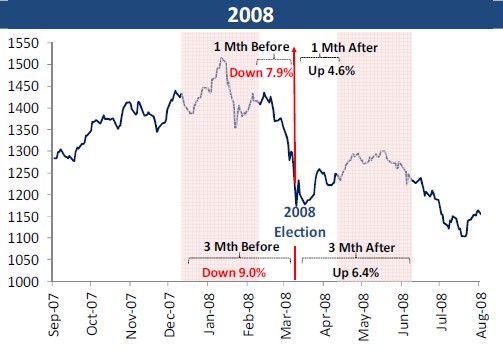
FBM KLCI performance before and after 2008 Malaysia's election
Strategy...
Sell-on-strength, especially overvalued defensive plays in the Consumer, Healthcare and Telco sectors and turn cash-heavy to accumulate high beta plays in domestic sectors, which are mainly related to Construction, Oil & Gas and Property sectors, in 1H13. Banking sector holds good buys based on their attractive valuation, still robust loan growth and bright chances of benefiting from ongoing domestic expansions.


Source: TA securities report

Monday, 8 October 2012

RHBRI Market Outlook & Strategy 4Q2012: Stormier Outlook


RHB research institute (RHBRI) is of the view that it could still be a choppy few months for the equity market in the 4Q given weakening economic fundamentals in the major world economies and fears of an imminent general election on the home front. Whilst more rounds of quantitative easing have been unveiled in the developed world, the big question in investors’ minds is how all these quantitative easing measures will translate to better global economic outlook. Having said that, equity still stands up vis-a-vis the unappealing returns of the alternative asset classes, such as cash and bonds and any good news is still likely to prompt a rally in equities.


How was Malaysia fared?
And, what's the strategy now?
Thus far, Malaysia has fared relatively well in the global financial crisis, and this is partly on account of low reliance on foreign funding of its banking system and more importantly, the progress in the implementation of the Economic Transformation Programme to boost domestic demand and cushion the economy against the downside risk from the external sector. As a result, the economy has bucked the trend and its real GDP growth is projected to pick up to +5.4% in 2013, from +5.0% estimated for 2012. This will translate to sustained earnings growth of around 6.0% in 2013 to create new shareholders’ values for investors.


We believe after a phase of correction and consolidation, the market will come back as the huge bond purchase programmes in the Eurozone and the US will push investors out of low-yielding cash and bonds over time into riskier assets such as equities. As the general election could be delayed to March 2013, our end-2012 FBM KLCI target remains unchanged at 1,690. Assuming global situations stabilize in six to nine months time and the global economic recovery is intact, our end-2013 FBM KLCI target is 1,815, based on 15x 2014 earnings.


Whilst our core strategy remains defensive, we believe investors would still need to accumulate fundamentally-robust stocks on weakness in order to outperform the market. In addition, as the search for yield will likely remain a key driver for both retail and institutional investors in the 4Q, high divided-yielding stocks will also continue to outperform the market, in our view. Sector-wise, our key overweight are telecommunications and banking, although we also have an overweight stance on the utilities and healthcare sectors.


Source: RHBRI research report

Friday, 7 September 2012

RHBRI 4Q12 Market Strategy: Stay Defensive And Buy On Dips To Outperform The Market

Given the persistent headwinds from the external sector and general election overhang on the home front, we are of the view that the market will likely be stuck in a range-bound trading pattern in the 4Q. Consequently, we believe investors would still need to accumulate fundamentally-robust stocks on weakness in order to outperform the market, while staying defensive on the core holdings will provide greater stability to the portfolio performance.
In addition, as the search for yield will likely remain a key driver for both retail and institutional investors in the 4Q, high divided-yielding stocks will also continue to outperform the market, in our view. A list of our top picks is reflected in table below, which includes “buy on weakness” tactical stocks.


Which Sector to look at?
Sector-wise, our key overweights are telecommunications and banking, although we also have an overweight stance on the consumer, utilities, gaming and rubber gloves under the healthcare sector (see table below). We expect the high-yielding telecommunications stocks to remain relatively defensive for equity investors under the current market environment.


The banking sector, on the other hand, carries a 34.7% weighting in the bellwether index and, in our view, cannot be ignored, given the better-than-expected recovery in earnings momentum over the last two consecutive quarters. The year-to-date annualized loan growth stood at 11.9%, ahead of our and the consensus forecasts of 10-11% and 8-9% and the pipeline of corporate deals remains healthy. This suggests that banking earnings could continue to surpass expectations in the quarters ahead, which coupled with decent valuations and dividend yields vis-a-vis the FBM KLCI benchmark, would bode well for share price performance in the 4Q, in our view.

Source: RHBRI research report

Friday, 4 May 2012

Outlook: SELL in May and Go Away? (May 2012)


Lackluster global markets. The Malaysian market sputtered in April after hitting a  record close of 1606.63pts early in the month. It then trended downwards together with most global markets, as political uncertainties in Europe sapped the strength of markets worldwide in the first half of the month, while political uncertainties at home dampened the KLCI in the second half of the month. This was indeed as per our expectations.


Outlook: Sell in May and Go Away?

We investigated the historical index performance over the months of May–Sept and Oct–April for the US and for Malaysia, Jakarta and Hong Kong to try and determine if there was any truth to the old adage. Analysis indicates that over the past 52 years in the US and 22 years in Asia, markets do indeed under-perform more during the months of May–Sept as compared to Oct–April, with the KLCI surprisingly emerging as a high beta market compared to the other three markets.


What goes up must come down
With the  historical trend speaking for itself and global markets performing robustly thus far in 2012, we therefore believe there is a strong risk for markets to retrace in May. Even though Malaysia has under-performed global markets year to date, a global slump may still put a dent in the Malaysian market. As such, we advise the following strategy for the month of May:

  • Sell early in the month with Blue Chips likely being sold down if the global market slumps
  • Buy defensive stocks early in the month, especially in the Mid and Small Cap consumer  space as some stocks here have not rallied in the 1Q
  • If markets come down significantly, ie, the KLCI drops below the 1550pts, then consider accumulating stocks in the Construction, O&G and Banking space on weakness


April Top Buys did well
Considering the 1.6% drop in the KLCI for April, our top Buys did well with 4 out of our Top 5 outperforming the KLCI and also returning a positive return for the month. This was due to our strategy of selectively picking stocks with their own specific catalysts in April. The only disappointment was  MMC that continued to be dampened by rumours of a delay in the IPO for Gas Malaysia.


Start off with defensives in May
With a potential drop in the market in May, we would recommend going defensive over a 1-month time frame. Those with a longer time frame could consider picking up cyclical as the market drops, but we do not have the luxury of that for our monthly outlook. The Top 5 are, therefore, familiar defensive names including telecom companies Axiata and Telekom Malaysia, consumer-related plays AirAsia (which may benefit from lower oil prices) and Media Chinese (benefiting from increased political interest) as well as TASCO, a small logistics company with reasonable dividend yields and a strong track record.


Source: OSK Research report

Monday, 2 April 2012

RHBRI: Market Outlook & Strategy 2Q2012


More Signs of Recovery
The tail risk from the euro-debt crisis has subsided after ECB opens its liquidity floodgates. Elsewhere, more signs of economic stabilization and recovery have emerged, particularly in the US. As the global economic recovery gains momentum, external demand for Malaysia’s exports will likely improve as the year progresses.

Domestically, consumer spending remains resilient, which will be reinforced by the progress in the implementation of the Economic Transformation Programme to sustain growth. We envisage the country’s economy to grow at 4.5% in 2012, albeit at a more moderate pace than the +5.1% achieved in 2011. This will underpin corporate earnings growth, projected at +12.2% and +7.9% for 2012 and 2013, respectively (+8.7% and +7.0% ex-Tenaga).


But, anticipate a short-term market pullback?

Notwithstanding improvements in the global economy, we continue to expect a market pullback and consolidation in the 2Q. In our view, apart from rising market caution ahead of the general election due to the uncertain election outcome, earnings will also have to play catch up for stocks with rich valuations before the market can scale new heights. On the external front, concerns on Mainland China’s economy and a potential risk of an oil-supply shock will also weigh down market sentiment.


Beyond the near-term pullback, we expect market sentiment to gradually improve as global economic uncertainties clear out. As central banks in advance countries have unveiled more quantitative easing programmes and pledged to maintain extremely loose monetary policy to support economic growth, global financial markets are still likely to be awash with liquidity. Consequently, we are maintaining our end-2012 FBM KLCI target at 1,650 based on 14.5x 2013 EPS.


Given our more upbeat view on the market for the 2H, we believe “buy on dips” is still the best strategy to outperform the market even though defensive stocks will provide greater stability for the portfolio, particularly in the 2Q. Sector-wise, our key overweight continue to be telecommunications, gaming, Plantation, oil & gas and consumer.


Source: RHBRI report

Thursday, 22 March 2012

Summary of 2011 Bank Negara Malaysia Annual Report

The global economy grew at a more moderate pace in 2011 after the strong rebound in 2010. The growth momentum was weighed down by continued structural weaknesses and fiscal issues in the advanced economies, geopolitical developments in the Middle East and North Africa region and the disruptive impact of natural disasters on global manufacturing production. These developments reverberated onto international financial markets and contributed to heightened market volatility throughout the year.


Despite the less favourable external environment, emerging economies continued to record firm domestic-driven economic growth. At the same time, emerging economies faced increasing challenges from volatile capital flows and rising inflationary pressures. Amidst this environment, the Malaysian economy continued to grow steadily underpinned by the expansion in domestic activity and firm regional demand.

The Malaysian Economy in 2011
The Malaysian economy recorded a steady pace of growth of 5.1% in 2011 (2010: 7.2%), despite the challenging international economic environment. Growth was lower in the first half of the year, particularly in the second quarter, as the economy was affected by the overall weakness in the advanced economies and the disruptions in the global manufacturing supply chain arising from the natural disaster in Japan. Although the global economic environment became increasingly more challenging and uncertain in the second half-year, Malaysia’s economic growth improved due to stronger domestic demand.


Outlook for the Malaysian Economy in 2012

  • Malaysia’s economy is projected to experience a steady pace of growth of 4 – 5% in 2012
  • Domestic demand to remain resilient
  • 2012 Budget expected to provide support to private consumption
  • Upward revision of public sector wages and one-off financial assistance to low and middle-income groups
  • Ongoing implementation of projects under ETP
  • Higher capital expenditure by both the Federal Government and the non-financial public enterprises
  • Implementation of the Special Stimulus Package through Private Financing Initiative


Labour market conditions are expected to soften in 2012 amid the slower economic activity. The unemployment rate is projected to increase to 3.2% of the labour force in 2012. Headline inflation is expected to moderate in 2012, averaging between 2.5 – 3.0%. The lower inflation projection reflects the moderation in global commodity prices and a more modest growth in domestic demand.

Source: BNM report

Thursday, 1 March 2012

OSK's March 2012 Outlook and Strategy


While Malaysia remained a laggard compared to the rally in developed markets, the global rally that had started in January finally dragged the local bourse kicking and screaming up during February with a rally of more than 3%. Globally, markets continued to rise despite the patchy fundamental landscape. Thus, while we had anticipated a potential rally in the 1st half of February, our expected market retraction in the 2nd half failed to materialize.


Top Gainers for February were dividend plays such as Carlsberg or companies with corporate activities such as Hartalega with its bonus issue or potential targets such as RHB Cap and MBSB. Smaller plantation companies such as TH Plantations and RImbunan Sawit also had a good run.

On the flip side, companies with poor results such as Maybulk, MAS and KNM got sold down. On a broader sectoral basis, telcos were the dominant play. It was the return of the Big Caps in February as the catch-up played by the KLCI meant that big caps ran up with the inflow of foreign funds.


KLCI year-end target set at 1,620 pts!!!

Moving forward, we unveil our KLCI year-end target at 1,620 pts. This is derived from the average of our 2012 and 2013 fair values at 1,466 pts (13.5x PER) and 1,775 pts (15.0x PER) respectively. We still believe that weak fundamentals justify a lower PER than the historical average of 16.6x for the KLCI. While we remain unconvinced of the current rally’s fundamentals and still see a risk of market correction, news flow with regards to large infrastructure investments should help the KLCI post a stronger 2H2012.


The derivation of our target is as such:
  • There is no change to our 2012 KLCI fair value of 1,466 pts based on 13.5x PER on 2012 numbers
  • We still believe that weak fundamentals justify a low PER for 2012 and that there may be mid-year weakness in global markets
  • We derive our 2013 KLCI fair value of 1,775 pts based on 15.0x PER on 2013 numbers
  • The higher PER of 15.0x is based on 0.5 std dev below the historical average 16.6x PER of the KLCI
  • We are still holding back from applying a historical average PER as we remain concerned on overall global economic fundamentals
  • Nonetheless, the global liquidity fuelling the current rally could continue to drive markets and the news flow with regards to large infrastructure investments should keep the KLCI buoyant in 2013. Hence, we apply a higher PER compared to 2012
  • Our 2012 KLCI year-end target is the average of the 2012 and 2013 fair value which gives a figure of 1,620 pts


Upgrading market call to NEUTRAL
Rolling forward our investment outlook horizon and nothing that the year-end target gives some 3.2% upside to the market, we upgrade our call on the market from Sell to NEUTRAL. Given our view that this is a Liquidity-Driven Rally with risk of correction, we recommend investors take a Balanced approach to the market for the remainder of 2012. As the market could still turn south in the middle of the year, we keep some Defensive stocks among our Top 10 Buys. At the same time, the burgeoning news flow on Construction and Oil & Gas means we recommend investors take some positions in these sectors. We, thus, expand our Top Sector calls from Consumer and Telcos to also include Construction, Oil & Gas and Banks.


Top Buys are a balanced mix
Our revised 2012 Top Buys represent a balanced mix of Defensive and Cyclical stocks with a range of deep value to reasonable yield plays. Our Top Buys are Maybank, CIMB, Axiata, TM, Gamuda among the Big Caps and Dialog, KPJ, QL, Padini and KimLun among the Mid and Small Caps.


For March, given the uncertainty remaining in the market, we introduce a balanced Big-Small-Cyclical-Defensive portfolio. As such, we select Maybank, CIMB, Axiata, Gamuda and KPJ as our March top buys.


Source: Excerpt from OSK Research report

Friday, 20 January 2012

CLSA Feng Shui Index 2012

In conjunction with the coming Chinese New Year, Finance Malaysia would like to bring to you another popular research report - funny and interesting - by CLSA. This year is called "Water Dragon" year. Is it a good or bad dragon? What does water means to this dragon? And most importantly, what's the predictions of markets from the angle of feng shui?


Prediction pattern patent pending
Past performance, as the tiny type whispers, is no guarantee of future behavior. After all, it may be no guarantee, but it's pretty much all we've got to go on. No matter how mathematically marvelous the model, how impossibly rational the behavior or how serial the killer instinct, not too far beyond the smirk and mirrors, precedent is invariably at play.


That the past is present in the future is fundamental to feng shui forecasting, which is why we slipped on the archaeological geomancy fancy-pants and took the pith helmets to pore over the charted remains of the most recent Wyrms Past - a sort of reverse inter the Dragons. Sadly, there's not much to seer among dem dry bones. A few scraps of scapula, but nothing oracular. Humerus? Not around this joint.

Would KLCI this year's pattern turn out to be like this?
We doubt that even market historian Yale Hirsch could discern any distintive Draconic DNA in the squiggles and highlights left and south. That they mark the start of every third Presidential Election Cycle doesn't help us much, especially given that Hirsch's theory has fallen flat of late. At the risk of straying into 'one hand clapping' and 'unknown unknowns' territory, perhaps that's the pattern: Dragons are simply predictably unpredictable.

Elemental Health Check:

Metals Sector:
Financials, Gold, Resources, Autos, Banks, Broking, Computer Hardware, Currencies, Dental, Engineering, Legal, Steel.

Wood Sector:
Retail, Agriculture, Education, Fashion, Forestry, Furniture, Garments, Packaging, Pulp and Paper, Plantations, Politics, Printing, Textiles, Traditional Media, Soft Commodities.

Water Sector:
Gaming, Transport, Fishing, Beverages, Marketing, Tourism.

Fire Sector:
Oil and Gas, Technology, Telecoms/Internet, Utilities, Accounting, Advertising, Aviation, Economics, Electrical Entertainment, Energy, Fast Food, Foundries, Petrochems, Services.

Earth Sector:
Agriculture, Building Materials, Cement, Chemicals, Construction, Developers, Government, Hotels, Human Resources, Cosmetics, Insurance, Management, Pharmaceuticals, Property.

Source: CLSA

Tuesday, 17 January 2012

Credit Suisse's 2012 Malaysia Outlook

After looking into all those research reports on 2012 market outlook by local securities or research houses, it's time for foreign research houses. In this series of 2012 outlook, we kick start with Credit Suisse's report, in which a section of it was written specifically on Malaysia. And, below is the excerpt from it.


Malaysia’s GDP growth to outperform its regional peers'?
Real GDP growth expanded 5.8% yoy in Q3, led by strong private consumption (7.4% yoy) and fixed investment (6.1% yoy), and a surge in government consumption (21.8% yoy). On a seasonally adjusted basis, we estimate that GDP expanded 4.6% qoq annualized in Q3, stronger than that of Korea, Thailand, Singapore, the  Philippines, Hong Kong, and Taiwan. Malaysia remains highly exposed to a sharp slowdown in the developed world, but, on a relative basis, we think its domestic demand will hold up better than that of the other small open economies in the region. We expect private consumption growth to remain robust, partly due to high palm oil prices. In addition, fiscal spending from the government should continue to help boost spending in the next few quarters. We think there is upside risk to our 2011 real GDP growth forecast of 4.6%. Our 2012 GDP growth forecast remains unchanged at 4.8%.


Fiscal boost ahead of the next general election?

With revenues coming in much higher than budgeted this year as well as the backloading of the planned expenditure, the government has room to boost spending in the next few quarters. The
government spent RM154bn in the first three quarters of the year. Its revised 2011 budget suggests that it plans to spend another RM76.8bn (9% of GDP) in Q4, which is 20% yoy more than it spent in Q4 last year. Moreover, in its 2012 budget, the government announced one-off cash transfers to the poor, bonus payments and pay rises for civil servants, as well as various tax exemptions. Most of these are scheduled to happen in early 2012, which should provide a boost to sentiment and private consumption. The ‘people friendly’ budget suggests that the general election, which needs to be held by March 2013, might be near. We expect the government to continue to pump prime the economy before the next general election.


The result of the general election will determine the prospects for structural reforms. The government announced in the budget speech that it will liberalize another 17 services sub-sectors in 2012, including medical, architectural, engineering, accounting, legal, education and telecommunications services. However, there has been no news on subsidy reform or the goods and services tax. We think Malaysia has made some progress in its reforms, as reflected in improved rankings in the global competitiveness index (calculated by the World Economic Forum) and ease of doing business survey (published by the World Bank). However, the less popular reforms have been postponed and appear unlikely to happen before the general election. Its ranking on Transparency International’s Corruption Perceptions Index has also slipped in recent years. Our base case scenario is that Prime Minister Najib will win the general election, but fall short of regaining the two-thirds majority lost in the last general election. The quality of the win will determine whether Najib will stay as prime minister and gain
enough support to push through further changes, in our view.


Monetary policy to stay defensive

With risks surrounding the euro zone remaining high and inflation likely to fall below 3% yoy in Q1 2012, we think BNM will remain data dependent and be ready to cut the policy rate if needed. Our forecast suggests BNM will keep the policy rate on hold until end-2012. However, if the global growth outlook deteriorates in the coming months, we think BNM has both the scope and willingness to cut the policy rate. Similarly, we think the ringgit will continue to trade in line with its regional peers in the near term. However, we think BNM might allow some ringgit out-performance if and when the euro zone situation stabilizes, given that Malaysia’s current account surplus remains strong, domestic demand resilient, and there are signs of pick-up in US economic activity. Domestically, the election result should also be an important determinant of capital flows. A poor outcome for the ruling party could lead to heightened political uncertainty and capital outflows.

Source: Credit Suisse

Saturday, 14 January 2012

Annual Strategy 2012 by TA Securities


2011 had triggered a wave of unwanted chain effects, which would not languish but resonate further into 1H12. While Japan is recovering from the worst ever tsunami and nuclear disaster, and oil prices stabilized after the unrest in the Middle East, conditions in Europe are expected to worsen before stabilizing.


Global Economy – Risk Factors Extending into 2012

Positive news flows on drastic measures to restore confidence in Europe and maintain the credit ratings of core economies could boost market sentiment in early 1Q12 and push the index to test the all‐time high of 1,597. However, the reality check on the implication of European austerity measures and rising market risk premium due to the 13th General Election (GE) could push the index around 1,200 levels in 1H12 based on a minus two standard deviation from its last decade’s historical mean of 16.6x.


A revival should ensue in the following months due to oversold conditions and anticipation of a subsequent recovery in Eurozone economy by mid‐2013 as markets move ahead by about six months. Our end‐2012 target is 1,520 based on a mid‐cycle PER of 13x.


Malaysia – Not Insulated


In the first nine months of 2011, the Malaysian economy registered a modest growth of 5.1% YoY thanks to the robust domestic demand and strong exports. In some ways, despite the turbulent external environment, rebuilding and reconstruction activities in Japan had helped spur Malaysia’s exports advancement during 3Q11. Nevertheless, the external sector is expected to remain challenging in 4Q11 before embracing a slowdown in 2012 amid the budget deficit cuts in the European Union, the slow economic rebound in the US and the anticipated softening of China’s economy. Hence, we expect Malaysia’s economic growth to narrow to 4.6% in 2012 following a 5.2% growth expectation for 2011.


On the fiscal front, the financial status of the Federal Government may continue to improve in tandem with the embodiment of fiscal prudence and boost in revenue. Overall consumer prices are expected to increase by 2.5% while monetary policy is expected to remain accommodative (OPR stable at 3.0%). A potential wild card is the reform agenda initiated by Prime Minister Najib Tun Razak. Factors that would accelerate reform include:
  1. increasing political consciousness and demographic shift,
  2. reenergizing investment in the local economy, and
  3. strengthening fiscal credibility. Sectors that could benefit are Banking, Property and Power.
Political Risk?
We strongly believe the country’s 13th general election will be due in 1QFY12, especially before the parliament convenes in March. This could be a major dampener upon dissolution of the parliament as investors would exit and remain on the sideline until the outcome is known and the implications are digested. The ruling coalition is expected to retain its victory but its grip on parliamentary and state seats are expected to weaken. Thus, the effectiveness in implementation of policy reforms and domestic expansionary measures could be compromised and will be closely watched in 2012. With the backdrop of slowing external demand, spending on domestic infrastructure, construction and oil & gas sectors would be the key focus in 2012.


Investors should take profit on any rally over the next three months and wait to cherry pick. Traders should take short‐term positions to trade, mainly on blue chips, in anticipation of a year‐end and New Year rallies and exit by March. We expect higher downside risks in 1H12 as the flow of negative economic data, earnings downgrades and possible 13th general election hurt investor sentiment.

Top Picks for 2012

We reiterate defensive approach in stock selection in current uncertain period and bottom up approach in choosing value picks. Preferred buy picks are KIANJOO (TP: RM2.58), SEG (TP: RM2.51), SUNWAY (TP: RM3.16), BJTOTO (TP: RM4.92), BSTEAD (TP: RM6.21), KPJ (TP: RM5.04), GENM (TP: RM4.50), SAPCRES (TP: RM4.93), GAMUDA (TP: RM3.71) and SIME (TP: RM10.12).


Source: TA Securities

Tuesday, 10 January 2012

Maybank 2012 Outlook & Issues: Tilt to Safety


2012 will be another volatile year, we expect, tracking closely headline news from abroad given unresolved macro conditions brought forth from 2011: high debts but low growth at the eurozone and US. Confidence continues to wane on a resolution to the debt crisis which is negative on sentiment and will destabilize growth.


We maintain our 2012 year-end KLCI target of 1,500 pts based on one standard deviation below mean on expectation of turbulence still at the external markets impacting sentiment and global growth. At the home front, it will be a year with potentially two major elections:
  1. an early 13th general elections (13GE) and
  2. UMNO party elections for the top posts in 4Q 2012, where the elected party president will helm the country’s premiership position
Air Pockets Ahead?

That eurozone’s debt crisis has stayed unresolved means that there is still default risk. We expect higher bouts of volatility in 1H 2012 where much of the PIIGS and US government bonds will mature. Other risks are potential deleveraging by the European banks which could lead to a credit crunch, which is recessionary in nature. The other risks are likely social uprising from tough austerity measures in the troubled economies and eventually, the fate of the euro itself.

Malaysia to out-perform, nonetheless. We expect Malaysian equities to out-perform again against a back-drop of external uncertainties and volatility. Cushioning the downside risk will be further traction on the ETP implementation, a resilient corporate earnings profile which is largely domestic focused, healthy corporate balance sheets, high domestic liquidity, stable foreign holdings, and strong participation of government linked investment funds in Malaysian equities.


Catalysts and news flow
  • Macro blueprints will be fewer in 2012 after the New Economic Model (NEM), Government Transformation Programme (GTP), Economic Transformation Programme (ETP) and 10th Malaysia Plan (10MP) were unveiled in 2010, followed by the Strategic Reform Initiatives (SRI), 2nd Capital Sector Masterplan (2CSMP) and Financial Sector Blueprint (FSB) in 2011. 2012 will be a year of implementation for these blueprints, in our view.
  • Nonetheless, the Malaysian market will not be dry of action with 3 major IPOs lined up in 1H: Gas Malaysia, Felda Global Ventures Holdings (FGVH) and Integrated Healthcare. Also, the possible re-listing of Astro’s domestic operations and Malakoff, the listing of AirAsia’s Indonesian and Thai associates and AirAsia X, and the REIT-ing of KLCC Property and Kris Assets’ assets.
  • M&As will remain in flavour if market conditions stay, with the SapuraCrest-Kencana merger to complete in Mar 2012, creating a group of RM11b-RM12b in market value, either the 3rd or 4th largest in the oil & gas sector after Petronas Gas, Petronas Dagangan and Bumi Armada. We expect M&As to extend in the financial services (investment and Islamic banking) and oil & gas service providers.
  • Government’s equity divestment will also continue, including on Khazanah’s holdings. In the news presently is Khazanah’s potential sale of its stake in Proton (it now has a 42.7% holding). Also, MAHB may see new equity issuance, thus, diluting Khazanah’s 54% stake. These measures will raise the liquidity of the Malaysian bourse.

Market strategy
We will continue to exercise caution expecting the dividend stocks with largely domestic focused earnings, to market outperform. Our top picks are Public Bank, Telekom, Berjaya Sports Toto and Axis REIT. We will add on selected ETP related thematics in oil & gas (top picks: SapCrest, Kencana) and construction (Gamuda, Hock Seng Lee), and the value stocks (Sarawak Oil Palms, TSH Resources, Hartalega) for medium-term gains. Sector wise, we are overweight on construction, gaming (number forecast operators), oil & gas and REITs.

Source: Maybank Kim Eng Research Report

Saturday, 7 January 2012

RHB 2012 Market Outlook & Strategy: Another Challenging Year Ahead


As we head into 2012, a lot of uncertainty remains. On the external front, the euro-debt crisis remains unresolved despite five major attempts to stabilise it. Meanwhile, the economic conditions in the Eurozone are deteriorating rapidly with major indicators pointing to the region entering a recession. A deeper-than-expected recession in the Eurozone would leave few countries unscathed.


In particular, the US economy, which is still in low gear, will likely be severely impacted, while China may also be in for a more severe downturn as effects of potential policy easing will take time to filter down to the real economy.


Slower Eonomic Growth Envisaged For 2012?


The Malaysian economy will not be spared and will likely experience slowing export growth, though this will be cushioned by resilient domestic demand given the progress in the implementation of the Economic Transformation Programme. We expect the country’s economic growth to slow down more significantly to 3.6% in 2012, from +5.0% estimated for 2011. This points to weaker earnings growth, projected to slow from 10.5% to 7.8% during the same period for the FBM KLCI benchmark (ex-Tenaga).


Domestic Demand Likely Be More Resilient

With slowing economic growth, general election and multiple headwinds from the external sector, we believe investors will be in for another challenging year ahead. Given a number of significant risks in the horizon, our end-2012 FBM KLCI target is set at a conservative level of 1,480, based on unchanged 13x 2013 EPS. We expect a volatile 1H with sentiment gradually improving in the 2H as clarity on the global economy improves and investors begin to look forward to an economic rebound in 2013.

Non-election plays?

For investors looking for stocks that are less sensitive to the outcome of the election, we recommend KLK (one of Malaysia’s largest and independent plantation companies, with effi cient yields that have set the benchmark for the sector), Public Bank (large and defensive bank with a conservative and highly-regarded management), Digi (foreign-owned, well-run and in the broadly stable telecom industry) and Parkson (holding company for Parkson Retail Group listed in Hong Kong and Parkson Retail Asia listed in Singapore, with exposure to resilient retail growth in China, Vietnam and Southeast Asia). In addition, Sarawak stocks like HSL, Jaya Tiasa and Ta Ann are likely to be relatively immune, as the state election was already held in April, with two-thirds majority given to the incumbent Barisan Nasional-linked chief minister.


Strategy

As global headwinds remain strong and situations could get worse, we continue to advocate a defensive investment strategy, focusing on high dividend yielding stocks with reasonably good growth potential. Nevertheless, after a period of volatility, a recovery will undoubtedly follow and as such, we believe it pays for investors to accumulate fundamentally-robust stocks on weakness for tactical plays. Sector-wise, our key overweight are telecommunications, gaming, plantation, oil & gas and consumer.


Source: RHB Research Institute