Showing posts with label GDP. Show all posts

Tuesday, 21 August 2012

What's wrong with Malaysia in terms of GDP per Capita? (2012)

Addressing the issue, which Finance Malaysia thinks was critical at a time of globalization heats up, Malaysia needs to formulate and take action immediately without much hesitation. But, before we jump into action, we need to know the root of the problem. Right?

Exactly, we must find out the reason why we left behind other countries in terms of GDP per capita, which refers to the country's gross domestic products at purchasing power parity (PPP) per capita. According to Wikipedia, it was the value of all final goods and services produced within a country in a given year divided by the average population for the same year.


Why not using nominal GDP to measure national wealth?
Comparison of national wealth are also frequently made on the basis of nominal GDP, which does not reflect differences in the cost of living. Using a PPP basis is arguably more useful when comparing generalized differences in living standards on the whole between nations because PPP takes into account the relative cost of living and the inflation rates of the countries, rather than using just exchange rates which may distort the real differences in income.


Singapore is now the richest country in the world.
Where is Malaysia?
According to sources, some of the factors contributing to Singapore's forecast performance are its 'human capital' -- a skilled and educated labour force, the dynamic business environment, openness to trade, capital mobility and foreign direct investment. Also, it is worth noting that there is a global eastwards shift in economic activity -- Singapore is perfectly positioned to take advantage of this.


However, everything is not going well for Malaysia, although we are Singapore's closest neighbour. In terms of GDP, we moving nowhere for past few years amid competitive global environment. But, in terms of population, we believe we accelerated for past one year after government legalized some 1.6million foreign unskilled labourers. Please noted that they are non-taxpayers who consume all the benefits funded by us Tax payers.

On the other side, our brightest and brilliant are forced to mass migrate to other countries. This is a fact which is dampening the future of our country. It's sad because Malaysia supposedly was high on the list in terms of GDP per capita, given the plenty of natural resources that we had and strategic position we located in. Why?

The main reason lies within us, Malaysians. Don't blame the government. Don't blame other countries. Don't blame the statistic. Just blame ourself, Malaysians. A government was formed by its own people, and elected by us. All the while, we have this wrong mentality that we are blessed with valuable resources which can last us for a long long time. Does that mean that we do not need to compete?

Facebooking is a new norm in workplace now.
If you were to ask, Finance Malaysia would take the blame on our mindset, especially youngsters nowadays. Most of them didn't bother about the country and their future. These people go to work for the sake of working only. They follow instructions, without reinventing the way we work. How are we going to excel? Don't even think about competing. It's about time to change for a better tomorrow.

Tuesday, 24 April 2012

Impact of minimum wage policy from an economics perspective


Continue from previous post on "New Minimum Wage Policy", here we analyze the impact from an economics perspective. Many people said the new policy will jack-up the inflation figures due to higher production costs. Subsequently, it will dampen the GDP growth numbers. Is it true?


The impact on inflation and GDP growth is ambiguous. Setting a minimum wage would boost wages and consumption for workers who remain employed (likely to be the more productive workers, working in companies that have higher profit margin), but would hurt the profitability of businesses that are labor intensive and could potentially lead to higher unemployment rate.


The impact on growth will likely be a net negative in the short-run as it might result in raised cost without an increase in productivity. In the long-run, this policy may bring about a positive impact if it succeeds in encouraging workers to upgrade their skills or for companies to invest more capital to boost productivity.

From an economic standpoint, the minimum wage policy is not the best way to help the lower income households. A gradual phase-in of the minimum wage should help reduce some of the negative impact.

Unless the introduction of the minimum wage policy leads to a widespread upward adjustment in wages, there shouldn't be a significant impact on inflation.


Some SMEs claim that a minimum wage would bankrupt small firms which rely on cheap labor, from Indonesia, Myanmar and Bangladesh. The Malaysian Federation of Employers, whose members collectively hire 2 million workers, said it wants an exemption for the smallest employers and for the policy to be implemented over several years. Ex-PM Mahathir Mohd, who is very influential in the political scene, is also against the minimum wage policy as he believes that it would hurt Malaysia’s competitiveness, especially during economic challenging times.


Source: Credit Suissue report dated 19th March 2012

Thursday, 22 March 2012

Summary of 2011 Bank Negara Malaysia Annual Report

The global economy grew at a more moderate pace in 2011 after the strong rebound in 2010. The growth momentum was weighed down by continued structural weaknesses and fiscal issues in the advanced economies, geopolitical developments in the Middle East and North Africa region and the disruptive impact of natural disasters on global manufacturing production. These developments reverberated onto international financial markets and contributed to heightened market volatility throughout the year.


Despite the less favourable external environment, emerging economies continued to record firm domestic-driven economic growth. At the same time, emerging economies faced increasing challenges from volatile capital flows and rising inflationary pressures. Amidst this environment, the Malaysian economy continued to grow steadily underpinned by the expansion in domestic activity and firm regional demand.

The Malaysian Economy in 2011
The Malaysian economy recorded a steady pace of growth of 5.1% in 2011 (2010: 7.2%), despite the challenging international economic environment. Growth was lower in the first half of the year, particularly in the second quarter, as the economy was affected by the overall weakness in the advanced economies and the disruptions in the global manufacturing supply chain arising from the natural disaster in Japan. Although the global economic environment became increasingly more challenging and uncertain in the second half-year, Malaysia’s economic growth improved due to stronger domestic demand.


Outlook for the Malaysian Economy in 2012

  • Malaysia’s economy is projected to experience a steady pace of growth of 4 – 5% in 2012
  • Domestic demand to remain resilient
  • 2012 Budget expected to provide support to private consumption
  • Upward revision of public sector wages and one-off financial assistance to low and middle-income groups
  • Ongoing implementation of projects under ETP
  • Higher capital expenditure by both the Federal Government and the non-financial public enterprises
  • Implementation of the Special Stimulus Package through Private Financing Initiative


Labour market conditions are expected to soften in 2012 amid the slower economic activity. The unemployment rate is projected to increase to 3.2% of the labour force in 2012. Headline inflation is expected to moderate in 2012, averaging between 2.5 – 3.0%. The lower inflation projection reflects the moderation in global commodity prices and a more modest growth in domestic demand.

Source: BNM report

Monday, 20 February 2012

Who can Save GREECE? (Feb 2012)

It's the time again for Greece to convince its counterparts that they are serious in cutting budget deficits. By doing so, Greece was to put on the lifeline (bailout) by European Union (EU) once again. The discussion of whether to save or not to save Greece had been dragging for one week time now. Why?


In Chinese, we say "we cannot see people die by not lending our hand". That's why China said they will help when the time arrives. The question is when is the right time? Until Greece go bankrupt? Or,  until Greece left EU?

Who can save Greece?
The answer to this very important question is very obvious. In Christian, they always emphasize on "we should take responsibilities on what we did", right? So, the solution lies in Greece hands. Not the country, but, the citizen, the people of Greece. It's time for them to come back to reality. Let's take Malaysia as a benchmark, they are working fewer hours than us, yet they are earning much better than us. GDP per capita of Greece is more than twice of our figures. How are they going to sustain whatever they are having now, such as attractive pension scheme and healthcare?


Technically, Greece already bankrupt with Debt to GDP of over 140. What does this mean? For every RM1 they earn, they spent RM1.40. It's overspent, it's over leveraged. It's time for Greece to unite together, shoulder the responsibilities with their Government, by taking pay cut, reform the pension scheme and healthcare system. By doing so, then only Greece can come out from debt crisis. Although the period is difficult, they must did it, don't procrastinate anymore. The longer they drag, the debt may snowball until a stage where "too big to burst".


Finance Malaysia really hopes Greece can come out of the bad times by themselves proudly. This goes to Italy, Belgium, Ireland, and Portugal too. We shall support Greece by visiting the beautiful country (of course, until all the riots were end).

Tuesday, 17 January 2012

Credit Suisse's 2012 Malaysia Outlook

After looking into all those research reports on 2012 market outlook by local securities or research houses, it's time for foreign research houses. In this series of 2012 outlook, we kick start with Credit Suisse's report, in which a section of it was written specifically on Malaysia. And, below is the excerpt from it.


Malaysia’s GDP growth to outperform its regional peers'?
Real GDP growth expanded 5.8% yoy in Q3, led by strong private consumption (7.4% yoy) and fixed investment (6.1% yoy), and a surge in government consumption (21.8% yoy). On a seasonally adjusted basis, we estimate that GDP expanded 4.6% qoq annualized in Q3, stronger than that of Korea, Thailand, Singapore, the  Philippines, Hong Kong, and Taiwan. Malaysia remains highly exposed to a sharp slowdown in the developed world, but, on a relative basis, we think its domestic demand will hold up better than that of the other small open economies in the region. We expect private consumption growth to remain robust, partly due to high palm oil prices. In addition, fiscal spending from the government should continue to help boost spending in the next few quarters. We think there is upside risk to our 2011 real GDP growth forecast of 4.6%. Our 2012 GDP growth forecast remains unchanged at 4.8%.


Fiscal boost ahead of the next general election?

With revenues coming in much higher than budgeted this year as well as the backloading of the planned expenditure, the government has room to boost spending in the next few quarters. The
government spent RM154bn in the first three quarters of the year. Its revised 2011 budget suggests that it plans to spend another RM76.8bn (9% of GDP) in Q4, which is 20% yoy more than it spent in Q4 last year. Moreover, in its 2012 budget, the government announced one-off cash transfers to the poor, bonus payments and pay rises for civil servants, as well as various tax exemptions. Most of these are scheduled to happen in early 2012, which should provide a boost to sentiment and private consumption. The ‘people friendly’ budget suggests that the general election, which needs to be held by March 2013, might be near. We expect the government to continue to pump prime the economy before the next general election.


The result of the general election will determine the prospects for structural reforms. The government announced in the budget speech that it will liberalize another 17 services sub-sectors in 2012, including medical, architectural, engineering, accounting, legal, education and telecommunications services. However, there has been no news on subsidy reform or the goods and services tax. We think Malaysia has made some progress in its reforms, as reflected in improved rankings in the global competitiveness index (calculated by the World Economic Forum) and ease of doing business survey (published by the World Bank). However, the less popular reforms have been postponed and appear unlikely to happen before the general election. Its ranking on Transparency International’s Corruption Perceptions Index has also slipped in recent years. Our base case scenario is that Prime Minister Najib will win the general election, but fall short of regaining the two-thirds majority lost in the last general election. The quality of the win will determine whether Najib will stay as prime minister and gain
enough support to push through further changes, in our view.


Monetary policy to stay defensive

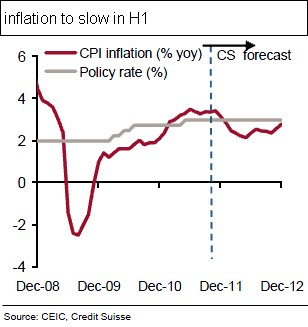
With risks surrounding the euro zone remaining high and inflation likely to fall below 3% yoy in Q1 2012, we think BNM will remain data dependent and be ready to cut the policy rate if needed. Our forecast suggests BNM will keep the policy rate on hold until end-2012. However, if the global growth outlook deteriorates in the coming months, we think BNM has both the scope and willingness to cut the policy rate. Similarly, we think the ringgit will continue to trade in line with its regional peers in the near term. However, we think BNM might allow some ringgit out-performance if and when the euro zone situation stabilizes, given that Malaysia’s current account surplus remains strong, domestic demand resilient, and there are signs of pick-up in US economic activity. Domestically, the election result should also be an important determinant of capital flows. A poor outcome for the ruling party could lead to heightened political uncertainty and capital outflows.

Source: Credit Suisse

Tuesday, 27 December 2011

CIMB: Domestic Drivers to steady the ship in 2012

CIMB research remain cautious on Malaysia's growth outlook for 2012 as several factors will put the brakes on growth - slower export growth due to the fragile western economies as well as slower consumption and investment growth due to heightened uncertainty and volatile financial markets. The implementation of ETP and stimulus measures cannot take up all the slack left by weak exports.

Slowing growth, rising risks
We expect GDP growth to slow to 3.8% in 2012 from an estimated 5% in 2011. The factors that shape the prognosis are:

  1. continuing weak global growth, pressured by volatile financial markets and Europe's sovereign debt worries;
  2. a downturn in Malaysia's export cycle;
  3. an expected slowing of consumption and investment due to worries over economic conditions

What to expect in 2012?
While not forecasting a global recession, a combination of fiscal tightening and a potential bigger financial shock from the debt crisis are expected to result in weaker global growth in 2012.

  1. Limited growth for the US economy. Its recovery is fragile and could succumb to any big external shocks, especially from Europe. This could lead to a double-dip recession. The sluggish recovery of the labor market as well as housing deflation will dampen household spending.
  2. The Eurozone is already in recession in 4Q11 and this will persist in 2012 as the persistent sovereign debt worries, volatility in financial markets and fiscal austerity will weigh significantly on growth. These braking factors will certainly raise the risk of more severe deleveraging, credit contraction and economic drag as the negative feedback loop between the banking system and the real economy becomes entrenched.
  3. China and India to continue growing, albeit at a slower pace due to the laggard impact of monetary tightening measures as well as a less favourable external environment. There are still fears of a hard landing for China.


Domestic demand cushions against weaker exports
With the export engine throwing a spanner in the works, the pressure is on domestic demand to keep the economy going, underpinned by both private spending and public investment. The key drivers of consumer spending are stable income and favorable employment prospects. But concerns over weaker growth prospects and volatile stock markets will bite into discretionary spending. Also, global uncertainties will throw a damper over the investment activity.

Macroeconomic policies: What to expect?
For 2012, the government is not straying from its path of fiscal sustainability as it targets to bring down the budget deficit from 5.4% of GDP in 2011 to 4.7%. The high level of debt constrains the government's ability to take on additional risk on its balance sheet. If the country does not commit to a credible fiscal reduction plan, it runs the risk of a downgrade of its credit rating in the event of a major change that pushes the fiscal deficit off track.


Monetary policy will continue to support activity
There is still a risk of food inflation. For 2012, inflation was expected to moderate to estimated 2.2% due to:

  1. weaker economic growth;
  2. easing commodity prices;
  3. a high base due to the fuel and sugar price hikes in 1H11

Persistent growth concerns, both global and domestic, coupled with expectations of easing inflationary pressures will enable the central bank to maintain an accomodative monetary policy. The tone of its policy statement on 11 Nov 11 suggests that growth is more of a worry than inflation, signalling the central bank's readiness to reverse its monetary course if domestic conditions deteriorate. An early rate cut in 1Q12 is still a possibility and end-2012 OPR to be targeted at 2.50-2.75% (3% at end-2011).

Source: CIMB Research

Friday, 18 November 2011

Key Highlights of BNM 3Q11 Report


Titled as "ECONOMIC AND FINANCIAL DEVELOPMENTS IN MALAYSIA IN THE THIRD QUARTER OF 2011", Bank Negara Malaysia (BNM) review some interesting facts on the status of our economy and the market outlook going forward. The announcement was chaired by Central Bank's governor to address the media after the closing of Bursa Malaysia.


Growth improved in the third quarter

Despite the challenging environment, Malaysian economy registered a higher growth of 5.8% (2Q11: 4.3%), due to stronger domestic demand. The robust  domestic demand was driven by an expansion in both household and business spending as well as higher public sector expenditure. Manufacturing sector recording a significantly better performance supported by firm regional  demand for resource-based products, coupled with the normalisation in supply chain disruptions arising from the Japan natural disaster.

The headline inflation rate, as measured by the change in the Consumer Price Index (CPI), rose to 3.4% on an annual  basis in the third quarter (2Q 11: 3.3%). The increase in consumer prices was largely the result of higher prices in the food and non-alcoholic beverages category.

Current  account recorded a larger surplus of RM26.6 billion, equivalent to 12.5% of GNI due to a higher goods surplus and lower income deficits. As at 31 October 2011, International Reserves position had increased to RM429.1 billion, equivalent  to USD134.8 billion, sufficient to finance 9.9 months of retained imports and is 4.1 times the short-term external debt.

Monetary policy is supportive of economic activity
The Overnight Policy Rate (OPR) was  left unchanged at 3.00% in the third quarter of 2011, following a 25 basis points increase in May. The stance of monetary policy is consistent with the assessment of heightened uncertainties arising from global developments that have created greater downside risks to growth.

The ringgit depreciated against the US dollar in the third quarter, in line with other regional currencies. The depreciation, mostly in September 2011, reflected mounting concerns over the European sovereign debt crisis and the sustainability of global economic recovery, which led to higher risk aversion and prompted some investors to unwind holdings of emerging market assets.


Thursday, 27 October 2011

Will Thailand flooding with Debts after this?

Oh my god. Another disaster has occurred, and this time is Thailand's turn. Finance Malaysia would like to offer condolences to Thailand for its massive damage caused by floods. This is not an ordinary floods, please read the numbers below then you will know.

  • worst floods in 50-years!!!
  • more than 300 lives gone
  • affecting nearly 9,000,000 people


Started weeks ago at upper Thailand, the floods were spreading down to its capital - Bangkok - now. Bangkok has more than 12 million population. The situation can only get worse from here and everyone is fleeing the city, searching for higher grounds and off to vacation. People are snapping up dry foods, fresh waters and daily products, hoping to brace through the difficult periods.

Will Thailand went into recession?
With Bangkok being the major engine of the country, many economists are expecting that the strong flooding in Bangkok would severely impact Thailand's GDP growth. Bank of Thailand (BOT) already downgrading their growth forecasts for this year to below 4%. Not yet negative, thanks to the first half of 2011. So, no recession yet unless there is not drastic measures taken by the newly elected government.

How serious is it?
First, the industrial parks in Ayutthaya provinces where houses many factories of multi-national companies are heavily impacted by floods. Obviously, Japanese automobile manufacturers being the hardest hit. Honda and Toyota already shut down their productions. Together with other companies situated there, their earnings sure will be affected.

Second, banks will be impacted by higher non-performing loans (NPL), in which companies and borrowers affected may not able to repay their loans.

Third, businesses in the city closed doors to prevent flash floods and riots that may happened. Domestic consumption will slow, very slow.

Forth, agriculture land was damaged. This will severely impact those rural people, and they have to takes weeks (if not months) to resume their activities.

Fifth, slowdown in sales for property developers is inevitable.

Sixth, flights and other transportation services disrupted led to earnings downgrade on companies such as airlines.


How about its impact to other countries?
While it was a bad experience for Thailand, other countries may benefiting from this episode such as Malaysia and South Korea. Why? Simply because those affected companies may swift their operations to other countries. Then, why Malaysia and Korea?

The most affected companies is from Japan, dealing in automobiles, digital camera and hard disk drive businesses. So, Japanese companies may potentially swift their operations or supply chains, either temporary or permanently, to Malaysia due to its strategic location and labor markets. 

Other than that, South Korea also is an ideal place for Japanese companies. We have seen this after the Japanese tsunami and nuclear crisis this year. This is not new anymore. Some interesting growth may surfaced in the automobiles and technology sector in South Korea.


What should be investors' positioning right now?
Generally, I don't think that Thailand will go into recession. Slowdown Yes. Thailand has more than enough financial resources to rejuvenate their economies. The rebuilding exercise should not be a problem. What we concern most is the execution part (just like Japan). For this investors should keep investing in Thailand selectively. Avoid banking, automobiles, agricultural and property sectors. Instead, hunt for those attractively priced counters in building materials, construction and healthcare sectors.

Countries wise, chose Malaysia and South Korea for the above mentioned reasons.

Saturday, 8 October 2011

4 Interesting Questions on Budget 2012

Well, well, well... The newly announced Budget 2012 seems to be a very holistic one, which covers almost everyone (even the opposition MPs). In the budget, a total of RM232.8 billions was allocated to implement all Government development plans, which include the projects and programs under various plans, focusing on the well-being of the rakyat. But, there are a few interesting questions that Finance Malaysia would like to highlight here.


1) Is it too optimistic?
As we all know, the external environment is becoming more challenging once again due to slowdown in US, Europe and Japan (if not double-dip recession). This would definitely impact Malaysia as manufacturing sector still playing a crucial role in our country's growth. While IMF is revising downward the global growth next year, our Government is projecting a 5 - 5.5% growth this year, and 5 - 6% for 2012. I think we should be very happy if Malaysia can grow more than 4.5% for 2011 and 2012.


2) Budget Deficit to come down?
Taking into account the estimated revenue and expenditure, the Federal Government deficit in 2012 is expected to improve to 4.7% of GDP compared with 5.4% in 2011. As we all know, Petronas is the main contributor to Government's revenue, which is heavily relies on crude oil prices. How much is the estimated price Government based on 2012? It does not stated. Of course, it should be lower than current year. Am I correct?


3) Construction sector to be one of the main growth engine?
By setting a 7% growth forecast for Construction sector next year, is it too optimistic (yet again)? Given the current state of delayed tendering process, land acquisition dispute and change of project owners (MRT project), I doubt the execution part of the beautifully layout projects. Do remember that Hong Kong and Singapore takes more than 5 years just for planning for their MRT projects. And, if we can kick-start so soon, sure Malaysia Boleh!!!


4) Is it really Rakyat-centric?
Just as rakyat coping with high living cost, especially in urban areas, there is some relieves after the Government's latest various incentives and rebates. Subsidies on some of the basic food items were continued. Concurrently, our MPs also have higher allowance. This seems like a win-win situation. However, would the Government forgot about another very important item - petrol? As promised earlier, our petrol prices are adjusted according to market price. Judging from the fallen crude oil prices lately, why Government still not yet lower petrol prices? I believe this is definitely a better and more effective way to help rakyat.

Saturday, 27 August 2011

4 Components of Economic Growth (August 2011)

So far, equity markets are down anywhere between 10-20% and bond yields in a number of major markets are reaching historic lows. Although it is difficult and nerve racking, investors should understand some of the forces behind what's creating this volatility and how they're likely to play out in the near term.


When will market rebound?
Again, we simply cannot answer that million-dollar question. If I know, I won't be writing this article here telling you all stories and facts. We should have a longer term view, especially during volatile times when fears dominating the marketplace.

So, what are some of the driving forces behind?
If we go back to basics, the 4 components that really drive economic growth are Government, Consumer, Corporate, Import & Export. If we look at each individually, we can do better opinion, by analyzing them.

Government:
Since 2008, governments have played an increasingly dominant role in the markets that we're familiar with. They are expanding monetary policy, expanding fiscal policy, bailing out companies, regulating companies or buying companies. Who else can replace the government now? Of course, NO one. The government are now a fact of life in the markets and investment as we know it. Example, the Citigroup bailout had actually turned out to be a very profitable investment for US Government. Undeniably, we have to understand each movements of government in order to make returns from.


However, Government cannot runaway from political issues which may confused the markets. Everyday, we guessed what is Obama or Bernanke going to say next, what's ECB going to do, when is our next general election? As the market continues to test Governments and its policy continue to evolve, we are due for continued uncertainty and volatility in the market.

Consumer:
We as a consumer are going through a difficult time, especially in developed markets. We faced with higher taxes, unemployment and inflation, all eroding our disposable income which in turn makes spending power and confidence lower. Market falls because of lower consumption/retail figures, and this will further enhance fear in the eyes of the consumer in return.

Investment:
This is what ETP of Malaysia means: Private investment with Government facilitation. However, corporates is talking about managing their costs and having a good solid balance sheets with cash to avoid problems in downturns. Right now, they are the healthiest of the 3 domestic components towards economic growth. Government is indebted more than corporates. Companies with strong balance sheets are in a better positions in expanding, be it organically or through acquisitions, like what Google doing right now (taking over Motorola).


Picture taken from www.money4invest.com
Export-Import:
Lastly, developing countries are the main growth drivers in international trades. Still, they are growing, albeit slower pace. We need to keep an eye of it and it's impact between developing and developed countries.

In summary, we should not over-react given the volatility of the market. In fact, we should take this as an opportunity to take on good solid companies for long-term investing. I still see a lot of good companies trading at single digit P/E, some with good dividend yield too. Should you forego the chances?