Showing posts with label oil and gas. Show all posts

Monday, 11 June 2012

IPO: Gas Malaysia

Gas Malaysia Berhad (GMB) was established to sell, market and distribute natural gas and Liquefied Petroleum Gas (LPG). GMB is also responsible for the construction and operation of the Natural Gas Distribution System (NGDS), which is a system comprising 1,800km of gas pipelines and stations within Peninsular Malaysia owned by GMB. NGDS is connected to the Peninsular Gas Utilisation (PGU), which is the gas transmission pipeline across Peninsular Malaysia owned and operated by PGB.


GMB’s core business to sell, market and distribute natural gas to industrial, commercial and residential customers in Peninsular Malaysia via NGDS. In other words, GMB purchases natural gas from PGB and sells to GMB’s own customers at a profit margin. There are currently two players in Peninsular Malaysia’s natural gas distribution industry, comprising GMB and PGB. However, both serve different sets of customers, whereby GMB’s customer base consists of users that initially consume less than 2 MMScfd, whereas PGB supplies to PETRONAS customers consuming more than 2 MMScfd. Customers that initially consume less than 2MMScfd but subsequently increase their consumption exceeding 2MMScfd will remain as GMB’s customers.

Like a toll road?
Looking at it from a slightly different perspective, GMB’s business can be compared to that of PLUS i.e. a toll road operator. Basically, consider GMB’s pipeline infrastructure as a highway, while the “toll” is GMB’s absolute gross margins, i.e RM2.02-2.25, while the “cars” represent the volume of natural gas supplied to GMB’s customers. We believe this comparison is fair, as GMB does not bear the risk of volatile natural gas prices as it buys and sells natural gas at regulated prices. As such, further growth in GMB’s sales volume would further improve its economies of scale given that other costs are largely fixed administrative costs.


In February 2012, GMB signed a New Gas Supply Agreement (NGSA) with Petronas whereby effective from 1 January 2013, the maximum limit for GMB to supply to its customers individually will increase from 2 MMScfd to 5 MMScfd. The NGSA has a 10-year tenure with an option to extend for an additional 5 years. In addition, GMB also supplies LPG to consumers in Peninsular Malaysia.


Strong cash pile, 100% dividend payout for FY12. Management indicated that it will spend RM140-RM150m in FY12 for the expansion of GMB’s Natural Gas Distribution System and RM40m p.a. in both FY13 and FY14 for maintenance purposes. We think that it is possible for CAPEX to be funded internally, judging from the group’s huge cash pile of RM327m and retained earnings of RM360m as of Dec 2011. Besides, GMB is also committed to paying out 100% of its FY12 net earnings as dividends and it is targeting a minimum payout ratio of 75% from FY13 onwards.


Source: TA Securities, OSK Research, RHB Research Institute

Tuesday, 5 June 2012

OSK Research: 1Q2012 Report Card and Strategy (June 2012)

In the recently concluded 1Q2012 reporting season, a similar number of companies under our coverage underperformed, at 31% versus 32% in 4Q2011 and 34% in 3Q2011. The percentage of companies that outperformed fell to 14%  from 17% in the previous quarter (see Fig 1) and 15% in 3Q2011. Surprisingly, there were more earnings letdowns among the big caps, with 27% missing estimates versus 17% in the preceding quarter while among the small caps, more companies trumped estimates - at 20% - compared with 12% in 4Q2011. The notable positive surprises among the big caps were Maybank and JCY while the negatives were from MAS, the Genting Group and MISC.


Steel, plantations and oil & gas disappointed.
The steel, plantations and oil & gas sectors were  dogged  by industry-specific issues and the macro-economic environment. Most steel companies that we cover continued to be mired in losses due to weaker selling prices and high material costs while plantation companies suffered production setbacks and higher input cost. Oil & gas companies were drenched by the monsoon season and the dearth of new contracts, which are only expected to pick up in 2H2012. The Genting group of companies saw earnings skimmed by the poor showing from the domestic and Singapore gaming units as well as its plantation outfit.


But consumer, financials/insurers gave reason to cheer.
As expected, the sectors in better shape were those with relatively more stable and defensive earnings and which had benefited from the Chinese New Year demand. Here, the breweries and retailers stood out. There was also the positive fillip for financial related insurance companies due to the adoption of the Malaysian Financial Reporting Standard (MFRS1) during the quarter.    


Given the potential bugbears in the form of:
  1. the upcoming make-or-break elections for Greece slated for 17 June,
  2. possibility of a Spain bailout,
  3. FOMC’s meeting on 19-20 June, and
  4. the technical violation of the US markets last Friday,
there are enough reasons for investors to stay defensive while positioning for rebound trades in the event of a sharp pullback. The upcoming listing of 2 major IPOs (Gas Malaysia and Felda Global Ventures) should provide near-term catalysts and support for the FBM KLCI. We like the banking, consumer, construction and oil & gas sectors.

In short, market is turning more cautious, so do investors...


Source: OSK Research

Sunday, 21 August 2011

Oil & Gas: Why Malaysia is different? (21 Aug 2011)

With oil prices hovering around USD80-85 per barrel currently, what is the outlook for Malaysia oil & gas (O&G) industry? Dubbed as "Black Gold", crude oil is one of investors favorite asset classes, which is highly volatile. Here, we examined the implications of lower oil prices, current scenario of the industry, and sustainability of oil price going forward. Feel free to share this out via our Facebook page (www.facebook.com/financemalaysia).


What drags down oil prices?
As most of you already know, US and Europe is main culprit for the sliding oil prices. High debt issues still lingering the global economy since 2008 global financial crisis. As such, the potential slowdown in the global economy as per investors perception, droves oil prices lower to current level.

What is the implications?
Actually, the correction of oil prices is driven by sentiment of traders, whom thinking that the demand is going ton be weak soon. What would you do if you're a CEO of Shell? Cutting back on oil exploration spending, re-evaluating the feasibility of planned projects, or even delaying some of them. At worst, you already seen it during 2008 financial crisis, where KNM battling for survival when a few of its clients delaying projects.

Oil prices outlook?
We believe the price of crude oil will trend lower in tandem with easing demand as industrial activities slow down. OSK had revising downwards their oil price forecasts for FY11 and FY12 to USD85-95/barrel and USD80-90/barrel respectively. Immediate resistance at USD90/barrel, while support at USD70/barrel.

Why Malaysia is different?
Unlike other countries, local O&G players are more dependent on our big boss - Petronas. Why? Because, Petronas is the one who is feeding the local players by dishing out marginal oil fields contracts and higher capex committed for next 10 years. No matter how global oil prices trend, Petronas is the growth engine of local players.


Target Price by OSK Research dated 19 Aug 2011

Buy or Sell?
Based on our reasons given above, we should Buy those companies which have strong relationship with Petronas (higher chances of getting contracts) and Sell those companies with excessive foreign contracts. This assumption is correct if oil prices are trending lower. As such, I picks Kencana (strong relationship and earnings) and Dialog (sound business with recurring income).

Friday, 15 July 2011

New IPO: Bumi Armada

Bumi Armada Bhd (BAB) is seeking a listing on 21st July 2011 with an enlarged share capital of 2.93bn shares of RM0.20 each on the Main Market of Bursa Malaysia. Based on the retail IPO price of RM3.03 per share, BAB will have a market capitalization of RM8.87bn. It expects to raise gross proceeds of about RM1.95bn from the flotation. Some 38% of the proceeds will be used to pare down bank borrowings while 29% and 28% will be used for capital expenditure and working capital respectively. The balance 5% will be used to pay listing expenses.


Company Profile
Bumi Armada Berhad is the largest owner and operator of offshore support vessels in Malaysia and is an established and trusted service partner in the oil and gas industry. It had established a strong position in FPSO systems, a growing Transport & Installation business and competency in management of large projects.

With head office in Kuala Lumpur, Malaysia and shore-bases in several countries around the globe, BAB currently serve clients in South East Asia, Congo, India, Mexico, Africa, Venezuela and the Caspian Sea region

Principal Activities

BAB has 4 main business units, which are:
  1. floating production, storage and offloading system (FPSO)
  2. offshore support vessel (OSV)
  3. transport and installation (T&I)
  4. oilfield services (OFS)
It also has 2 support units, which are:
  1. fleet management services (FMS)
  2. engineering, procurement and construction (EPC)
Nevertheless, the company’s bread and butter is its FPSO and OSV business, which generated about 45% and 55% of revenue in FY09 respectively and 44% and 34% in FY10. BAB’s record of consistent execution and its in-house expertise throughout the value chain allows the group to expand its vessel deployment footprint beyond its base in Malaysia to more than 10 countries in Asia, Africa and Latin America.


Investment Catalysts:
  1. High oil prices to support E&P spending
  2. Higher energy demand from global economic recovery
  3. Industry moving towards 1-stop solutions, where BAB's 3 combined core businesses would qualify it as a 1-stop solution provider
  4. Targeting a niche market in FPSO, which only a few FPSO owners in the market due to the high capex required
  5. Strong RM5.8bn order book and customer base, which should keep BAB busy over the next 2-3 years
  6. Active corporate branding
Valuation given by OSK Research:
We are initiating coverage on BAB with a Subscribe/Buy recommendation with fair value of RM3.65 based on sum-of-parts valuation. This is equivalent to a PER of 18x FY12 EPS, a valuation which is fair given the company’s sheer size and its ability to provide 1-stop solutions starting from the O&G exploration to decommissioning stage. Also, since an estimated more than 70% of its business provides recurring income and constant cash flow, the stock deserves a premium valuation over other local O&G supporting companies, who are dependent on one-off jobs.

Source: OSK Research dated 7 July 2011

Tuesday, 12 July 2011

Should we invest in Commodities or Resources? (July 2011)‏

Unlike real estate, assets type such as commodities and resources investments tend to be highly volatile. This kind of assets classes is suitable for high risk takers. Knowing the characteristic of the assets classes is important to suit your investment objectives so that a correct investment decision was made. However, I noticed that many investors confused about Commodities and Resources, and they often lumped them as SAME. Is it true? Let's look at it separately (not together).


Commodities vs Resources?
Yes. Both is similar, yet there are some differences between them. First, let's talk about commodities. Commodities for me were comprised of metals such as copper, iron ore, silver, gold, platinum... Although many of us includes energy assets such as oil and gas into it, we can categorize it as an asset class which we can't consume with our mouth. Sometime, it was called hard commodities.

Meanwhile, Resources are soft commodities. They comprises agriculture products and food, etc sugar, corn, wheat, soybean, palm oil... These are closely linked with our food and beverages. After understanding the basic of these two assets, let's us examine the next question.


Should we invest in Commodities or Resources now?
In view of the current scenario, I prefer Resources rather than Commodities. Why? Demand for wheat, rice and other resources tends to be more sustainable. Even if the global economy is going to slow down, we still have to eat or consume as it was a necessity.

Other than that, bad weather (due to global warming?) and natural disaster (due to end-of-the world?) had disrupted the supply of resources. Although commodities such as coal mining in Australia was affected too, food do more harm to human being. Without adequate resources, people may trade commodities for resources!!! Don't you?

What if the current high price of commodities was driven up by speculation? Even though demand and supply play their role here, but speculation and traders tend to make profit from the game. By manipulating the demand-supply story, they're in to drive up the prices, making it more pricier rather than purely based on the fundamental.

After all these points highlighted, would you invest in Commodities or Resources?


Tuesday, 24 May 2011

Government to increase electricity tariff? And, RON95 price? (24 May 2011)

Before Government making the decision on two of the most important necessity of Rakyat, let us make a guess first. I know this would be a hot debate on whether Government should increase the electricity tariff and RON95 petrol price. Actually, both are linked closely with crude oil - the black GOLD.


Electricity Tariff

For TNB, the revise is crucial for its sustainably of the company to continue electrified Malaysia's economy. In fact, this is a long overdue issue, delay and postpone until now. But, why now? I believes that Government, initially wanted to review the tariff once the much anticipated general election. But, the Sarawak state election result could have derailed the early election plan. If we don't review now, TNB may facing financial difficulties which may impact the cash flow and credit ratings of its debts. High natural gas price is affecting the bottom line of the company.
Petrol RON95 price
Comparing to its brother (RON97), we should be more than happy to still pumping at current price. The last review is on December 2010, and the 6 months grace period will end by June 2011. In other words, next month (June 2011) would be schedule to revise the price again. Actually, this is not a surprise move given that the Government had already gradually cutting subsidies since last year. And, he did mentioned that petrol price will be subsidy-free by 2013.


Conclusion by Finance Malaysia
Confidently, we predicts that Government will revise both electricity tariff and RON95 price UPWARDS. Inflation will shot up to 4% this year. BNM will continue its OPR hiking. Believe it? You can watch TV news and advertisements these few days. Government is "previewing" the increase, letting Rakyat to welcome it mentally. Not enough? That's why we saw news from economists saying that "Malaysia will Bankrupt, if Government do not cut subsidies". BNM governor is embracing the increase, saying "We can ride out high costs".

Friday, 1 April 2011

OSK Stock Picks for April 2011

After being hit by a few Black Swan events, markets rebounded in March with the KLCI ending 1Q in the black. Moving into 2Q, we still see some short term volatility but are confident of an eventual rally to close in on our year-end KLCI target of 1680 points. We advise investors BUY Big Caps on potential rebounds while focusing on the more defensive Small Caps given their superior performance over the past few months. The favorite sectors remain Banks, O&G, Property and Construction in the mid-to-short term while the longer term buys are Media and Healthcare. This strategy is reflected in our April top buys as well.


Timber the BIG winner...
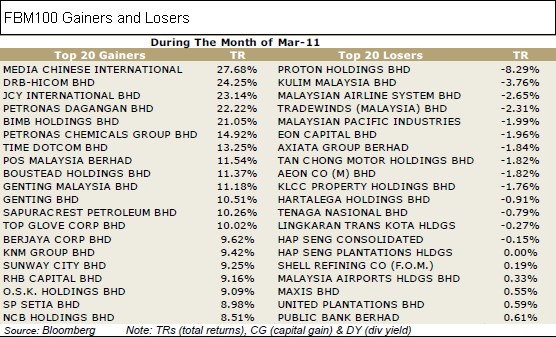
For March, timber stocks were actually the big winners, including names such as Suber Tiasa, Jaya Tiasa, TaAnn, WTK and Lingui, on hopes for better timber demand in view of reconstruction efforts in Japan. Nonetheless, these counters are not part of the FBM100. Instead, among the FBM100 constituents, media player Media Chinese and Petronas companies Petronas Dagangan and Chemicals were the big winners. Sectoral wise, O&G led the way followed by Technology (JCY), Media (MCIL), and Gaming (Genting).


Outlook: Moving into 2Q
Moving into 2Q, we see the possibility of some short-term volatility for the remainder of 2011 but market fundamentals remain sound. We maintain our year-end KLCI target of 1680 points based on an average of the 2011 KLCI fair value (1648 points 16x PER) and 2012 KLCI fair value (1710 points 15x PER). With this in mind, we maintain Overweight on the Malaysian market. Our view is driven by 4 key factors:
  • The economy will continue to grow
  • Upside and Downside are fairly equal
  • News flow ahead of the General Election remains very supportive
  • Earnings should match expectations


For April - A month of 2 Halves
We believe that there may well be 2 distinct halves in the month of April. The first half should be positive for the market, with the one of the key factors being the Invest Malaysia conference which will be held on 12 April. Among the announcements could be:
  • The disposal of Khazanah's stake in Pos Malaysia
  • The next Risk Service Contract for marginal oil fields
  • Release of Government lands for property development
However, for the second half of the month, we are concerned of greater market volatility, due to potentially less positive outcome of the Sarawak elections. Since BN already holding more than 80% of the state seats, we believe the risk is that their performance may drop in this upcoming election. Consequently, this may spark some knee jerk selling until the 1Q2011 reporting season.


Source: OSK Reseach Report

Saturday, 26 March 2011

Earth Hour by Switching-Off TNB's Nuclear Plan(t)? (26 March 2011)

In conjunction with Earth Hour today, would you do your part by switching off lights from 8.30pm to 9.30pm? I heard people are talking about earth hour since weeks before, and many shopping malls and hotels are organizing some amazing events during this special dark moment. Actually, the idea of Earth Hour came out as a way to showcase a growing global community's commitment to taking environmental action and protecting the planet we are living in.


And, this year, the one-hour is just like a moment for us to remember the lost lives in Japan earthquake and tsunami disaster, which killed more than 10,000 lives. Of course, the nuclear radiation treat are still looming in Japan, and we really needs to evaluate the effects.

But, isn't nuclear power GREEN?

As I know, nuclear power is much more environmental friendly than Coal/Gas power plant. Although Hydro power is renewable, it is devastating to the nature when construction by greatly changes the topography of the surrounding area and sacrificing the habitat of animals.

However, Japan's latest nuclear emergency is a wake-up call for aspirant TNB who is planning to build out nation's first nuclear power plant by 2015. It is likely to be hot debate in parliament and will soon become an "political agenda" in the upcoming general election.

Electricity Capacity as at June 2010. (Tenaga Nasional Bhd)

Do we really need Nuclear Power?
As of June 2010, 91% of Malaysia's electricity is generated by either gas, coal and oil. This is totally not environmental friendly. Hence, in June 2009, the Malaysian cabinet decided to include nuclear energy as part of an energy option for electricity generation particularly in Penisular Malaysia for post-2020. With the treat of climate change and the depletion of fossil fuel resources, it is no surprise that utilities worldwide are putting the nuclear alternative back on the table until the Japan disaster recently.

Other than nuclear, many people think that solar, wind and biomass energy which is renewable is an good alternative. But, it is ridiculous if we are to talk about constant and stable energy production and competitive pricing. Please bear in mind that, the more expensive power produced by TNB will translate into higher electricity tariff to consumers.

www.financemalaysia.blogspot.com

In conclusion, I think Malaysia needs Nuclear power and should proceed with the nuclear power project for sustainable power supply to power up our nation, continue growing in the future. We should not lag behind and must plan ahead for nuclear power because nuclear power plant needs 10 years to build and commissioned. The main concern for Malaysians, however, is the lack of expertise and maintenance of nuclear power. Government should address this problem thoroughly, and once solved, everything would be smooth sailing.
Source: Tenaga Nasional Bhd


Thursday, 17 March 2011

New Fund: RHB Dynamic Oil-Gold Capital Protected Fund

Launched on 11th March 2011, RHB Dynamic Oil-Gold Capital Protected fund is investing in oil and gold, which have the potential to perform in both areas that have great bullish and bearish markets.


This is a 3 years capital protected fund. As usual, it will invests at least 85% of the NAV in zero-coupon negotiable instruments of deposits. Meanwhile, up to 10% of the fund's NAV will invest in an over-the-counter (OTC) option that gave investors returns (if any).


The OTC option will provide exposure to the performance of the Option Strategy, which is an index, maintained by the issuer of the OTC option and is subject to a dynamic risk adjustment linked to the realized volatility of the underlying.

Option Strategy
This Option Strategy is a rules-based strategy computed and developed by the option issuer / counterparty. It aims to tap into the growth of oil and gold through the use of a "momentum" based strategy to capture the trends of the Underlying and also, volatility stabilization to reduce the exposure to the Underlying if the volatility is high.

The theory behind momentum strategy assumes that a leading performer from the last period will continue to be leading performer in the next period, while the volatility stabilization will protect investors against sudden changes in the Underlying prices.

How to determined the asset class?
In determining which asset class to invest into, the Option Strategy will look at the below rations:
  1. (gold price / oil price) spot ratio
  2. 60 days Moving Average (MA) of the Gold / Oil Ratio


To read the prospectus, please click here.
Source: RHB Investment Management

Related Posts:

Thursday, 3 March 2011

How far could Oil price RISES?

As usual, another episodes of tension in the Middle East pushes global oil prices higher, and surpassing $100 per barrel this time. We did seen this kind of scenario before in the Middle East during 1973-74, 1979, and the Iraq war in 1990. Are there any different this time?

Libyan leader Muammar Qaddafi

By Credit Suisse
We believe the rise in oil prices is manageable. Each 10% rise in oil prices only takes about 0.1% off global GDP and 0.2% off US growth. With Western wage growth muted, central banks are unlikely to raise rates on account of oil alone.

Our analysts see oil prices below $100 pb this year, supported by the following reason which differs from previous oil crisis:-

  1. There is enough spare capacity in the global oil market to deal with supply-side disruptions as long as they are not too extreme
  2. The energy intensity of global GDP has fallen by around 40% over the past 40 years
  3. There is unlikely to be the same inflationary follow-through as in the 1970s
  4. Oil producers are spending their windfall gains
Yahoo Finance: Oil prices since 28th Feb 2011

Potential Losers
Among the countries that are both significant energy importers and where energy accounts for a large part of the CPI basket, we would highlight India, Czech Republic and Poland. We note that China has the fiscal strength to subsidize higher energy prices, while other countries (namely India and Thailand) may not.

Potential Winners
In our view, the potential winners are countries that are net energy exporters and that have a positive output gap. This highlights Russia, Columbia, Australia, Canada, Malaysia and Norway.


The outlook for oil prices...
We believe that the oil price should fall from here. Saudi Arabia is likely to release some of its oil reserves into the market as it perceives a high oil price to be supportive for the Iranian government. Our house view is that oil price could falls below $100. We would only be concerned if the political unrest in the Middle East were to spread to Saudi Arabia.

* This is just an excerpt from Credit Suisse Research report dated 1 March 2011. This may not informative enough for readers to come to a conclusion.

Related Posts:
When would asset bubbles in Emerging Market "Burst"?


Wednesday, 2 March 2011

OSK Stock Picks for March 2011

By OSK Research,
Despite relatively strong results from a number of Blue Chips in February, the market still retreated and ended up in the red so far in 2011. Selling was largely attributed to concerns arising from political unrest in the Middle East although we continue to see limited risk if this does not spread to Saudi Arabia.

Go out and BUY?
Trading Strategy - Buy on Weakness
OSK continue to advise investors to Buy on Weakness in the current volatile market with focus on Banks, especially those that have been sold down recently as we still see robust loans growth of 8.5%. OSK also advise trading in Oil & Gas, Construction and Property counters as the news flow should remain good although they caution that profits will likely to kick in only in 2H of 2011.

March 2011 Top Buys
OSK's top buys did poorly for February, with only 2 stocks matching or exceeding the KLCI namely KPJ and Kencana. For March, as we remain hopeful of a market rebound, we are keeping CIMB, Kencana and SP Setia as our top buys. At the same time, we have added in defensive plays such as Petronas Gas and also retain KPJ.

Source: OSK Research
By Finance Malaysia,
While we are hopeful that the unrest in Middle East will eased soon, without spreading to Saudi Arabia, I think investor should trades cautiously as long as KLCI did not break free from the 1,500 psychological level. In terms of sector, I prefer Oil & Gas and Construction sector mainly because of Malaysia government's "preferred play". I view these sector as more defensive to global uncertainties, as Petronas and government is the main projects sources for O&G and construction sector respectively.

Related Posts:

Monday, 28 February 2011

Game-Over for Construction Sector? (28 Feb 2011)

All are going very well for Malaysia construction sector last year in line with the recovery of economy until it hit the first "hard bump" last week. We all know that construction sector is very volatile, influenced by the health of global economy, government's pump-priming projects, and of course the huge overhead costs such as labor and building materials costs.


Somehow, unrest at Middle East are hogging the bright future of Malaysia's construction counters. First, surging oil prices put pressure on the bottom-line of the companies. Second, projects from that oil-rich nations will dampened the outlook with a slew of Malaysian companies venturing successfully into that region.

The Game still going on?

According to CIMB Research, the selling pressure on construction stocks is overdone as jobs in the Middle East account for 3 - 41% of the order books of WCT, IJM Corp, Gamuda and Muhibbah Engineering and the projects are mostly at the tail end with no payment issues so far. 


For instance, IJM only has 3% order book exposure while Muhibbah's balance of works at NDIA 
is backed by the Qatar government's push to complete the job by end-2011. WCT has a geographical advantage in Qatar which appears to be at the lowest risk of a political unrest. As for Gamuda, its Middle East exposure is minimal.

However, Finance Malaysia opine that the panic selling is understandable given the past experience of LCL Corp. Before the 2008 financial crisis, and also with high oil prices (just like right now), LCL has a bunch of projects in Middle East especially Dubai. All seems pretty well, until a sudden sharp drops in oil prices landed the oil-rich nation into huge budget deficit. Subsequently, LCL is facing cash flow problems which forced the company being delisted. A company with great potential go burst in few months. Of course, traders do take precautions now to avoid that same fate.

But, given the continuous ETP projects being rolled out by government this year, and also the "election factor", I think construction sector is very happening at least for another few months. Government: "The game must go on?"

Related Posts:

Tuesday, 4 January 2011

2011 Malaysia Outlook: Sunshine to Sunset

By Finance Malaysia,
Driven by better economy prospects, Malaysia successfully escape recession two years ago, particularly March 2009. Strong GDP growth and numerous government's initiatives is the main reason why local market experiencing a spectacular run-up since then. Today, our KLCI break another record high, by closing at 1551.89 points. So, what is the outlook for Malaysia in 2011?
Maybank expects KLCI will hit 1,700 mark in 2011
KLCI
The Malaysia Index will continue to perform in line with the overall economy. More IPO will be issue. More merger & acquisitions activities will be seen. KLCI will be driven by the following factors:-
  • Improving sentiment
  • Follow through momentum from all time high
  • Hot capital inflows
  • Improving liquidity
  • Boost by plantation and oil & gas heavyweights, such as IOI, Sime and PetroChem
Preferred sector(s)...
  • Finance sector will continue to do well in line with the economy
  • 2011 will be a "Grammy Awards" show for construction sector, where government rolling out its multi-billion projects
  • Another show is from oil & gas sector, organized by Petronas
  • Property sector should continue chalking up sales with great demand
Sunshine to Sunset sector(s)...
Please take note that all is not so bright in 2011. Some of these sectors could face some turbulence in 2nd half of 2011. That's why I called it "Sunshine to Sunset".
  • Once high-flyers in difficult times, glove sector could be facing another whirlwind quarters with excess capacity and high input costs in the second half.
  • Besides glove, manufacturing sector would struggle because of electricity tariff hike imposed by TNB, speculating after Chinese New Year.
  • Technology sector will be a sunset sector next year due to stronger ringgit.
Bond market
Local bond market will boom, in conjunction with the projects awarding sessions and government's ambition to make Malaysia an Islamic financial hub. Local bond market will do well in the first half, before Bank Negara Malaysia resume its interest rate hiking policy later.

Tuesday, 21 December 2010

Super BIG Xmas gift for KNM

After a long suffering period, KNM investors can be very joyous coming this Christmas celebration with another good news announced today. In a statement after trading hours, KNM announced that its wholly owned subsidiary, KNM Process Systems Sdn Bhd (KNMPS), had landed a RM2.19 billion job in the United Kingdom.
The contract is for the engineering, procurement, construction and commissioning of works towards the development of an 80MWe gross capacity energy from biomass and waste recycling centre project known as EnergyPark Peterborough. Duration of the contract is about 4 years.

KNM drive into Renewable and Clean Energy Sector...
This mark another important milestone for KNM to venture into renewable energy sector, which is so popular in this energy-hunting world. This came as a surprise to investor because KNM had never been in that sector, and even surprising us was the multi-billion value contract.

Illustration of EnergyPark taken from Peterborough Community Website
The project was said expected to contribute positively to KNM's earnings for the financial years ending 31st December 2011, 2012, 2013 and 2014. At the same time, KNM order book rose accordingly, which could keep KNM busy for next few years.

Second contract this month
To recap, KNM (through KNMPS also) secured a RM680 million contract early this month in Uzbekistan for the supply of technical documentation, equipment and services for the development of gas condensate fields, which is for a 2 years duration.

KNM closed at RM2.69 today.
OSK and RHB are setting a fair value at RM2.96 and RM3.09 respectively now.
What would be the reviewed price after today?

Merry Christmas, KNM !!!

Wednesday, 8 December 2010

KNM – Good & Bad

Recently, KNM is coming back to the limelight in Bursa Malaysia. After the 4 to 1 share consolidation exercise, KNM is inching up since securing a contract worth RM680 million in Uzbekistan. Then, KNM held a briefing with research outfits indicating that the company was on the road to recovery after a hiatus one-and-a half year.

Good facts:
  • Order book had grown to RM2.4 billion
  • Tender book grown to RM16 billion
  • Better capacity utilization
  • Re-surging of crude oil price which touches USD90 per barrel now
  • Malaysia government's intention to spur oil & gas sector
  • Listing of Petronas' subsidiaries enhancing the viability of local listed companies
  • Impending projects roll-out by Petronas soon
  • Planning to tap into nuclear industry in Africa
IR. LEE SWEE ENG
Executive Chairman / Chief Executive Officer
Bad facts:
  • Foreseeable losses in its operations in Brazil, Canada and Indonesia
  • High debt levels with RM1 billion borrowings, against net cash balance of RM300 million
  • Future cash flows constraint would jeopardize the company credit rating
Would BUY Calls from ECM, OSK, HwangDBS, and RHB gave you some confidence?

Tuesday, 30 November 2010

New Incentives Plan for Oil and Gas‏


The government has endorsed a new plan of tax incentives proposed by Petronas which will be incorporated in the Petroleum Income Tax Act, Prime Minister said today.

“By lowering risks and increasing the rewards for investment, this initiative will potentially lead to additional petroleum-generated revenue of more than RM50 billion for Malaysia over the next 20 years” he said when announcing 9 new developments and Entry Point Projects of the Economic Transformation Program.


Najib said there would be a notional trade-off of about RM8 billion in the form of revenue foregone from investment tax allowances, reduced tax and the export duty waiver for marginal fields.

The 5 new incentives are:-
  1. Investment tax allowance of capital expenditure.
  2. Reducing tax rate from 38% to 25% for marginal oil field development
  3. Accelerated capital allowance of up to 5 years from 10 years.
  4. Qualifying exploration expenditure transfer between non-contiguous petroleum agreements with the same partnership or sole proprietor
  5. Waiver of export duty on oil produced and exported from marginal field development
Source: Bernama

Finance Malaysia (FM):-
"This is definitely a good perks for the oil & gas sector. The main objective here is to encourage deep water exploration, which is capital intensive and requiring more technical know-how."

"MHB which was listed recently could be the main beneficiary, judging by its expertise and available resources and technical in this field."

"Following the listing of MHB and Petronas Chemical Group, any good news announced would definitely excite the market. FM believe this is just one of the good news prior to the next general election, reportedly early next year".