Monday, 5 December 2011

The end of Europe’s liquidity crisis? (Dec 2011)

Well, many people already bored with the on-going Europe debt crisis, and subsequently liquidity crisis. This is like what we have seen in 2008 when Lehman Brothers collapses, which drags down the whole financial systems globally through liquidity crisis. The different is between company and country. Maybe some of us doesn't know how this chain effects rattles the global markets. So, let us start here.

The European Organisation chart of Debts
The root of the problem plaguing the market right now is Europe debt crisis, where Greece and few other European countries were highly in debts. They just simply cannot generate enough revenue (taxes) to support the economy itself. So, they resorted to seek for funding via borrowing by issuing sovereign bonds to finance their day to day operations. However, the debt is piling up intensively after 2008 global financial crisis until recently. Because the government does not have money, their bonds may go into default. So, they were forced to borrow some more, but with higher interest this round.

For them, this kind of measures are simply to prolong the problems and those debts were still there charging higher and higher interest. They are buying time, hoping their economies will survive and growing in the future to repay back whatever they borrow now. What a pretty picture?

Who is the main borrower?
Congratulations, the winners go to French banks. They are the main source of funding for these troubled ladden countries. As long as these banks charges those countries interests, everything is good for banks but bad for countries. What if those countries really go bankrupt? French banks may follow suits too.

So, the pretty solution is to write-off from the book of borrowers (French banks). Why French banks still need to accept the offer? Depending on the % of write-off, banks at least got something better than nothing. Right?


How the liquidity problem set in?
Debt writing-down means that the assets of French banks were being slashed. Last month, there is a 50% hair-cut for Greek debts and the amount will reflects in the books of these banks in the next few quarters. Now, you know why rating agencies are cutting 15 European banks' rating last week?

Sigh... But, not yet ends?
After the hair-cut, banks may having liquidity issues next. They doesn't have enough capital to borrow and this may dampened the whole financial system, thus, businesses and public facing difficulties to finance their expansion or consumption. Don't worry, angels were always by our side.

Angels (not Santa) come before Xmas...
Last week, 6 central banks globally take an important step toward dealing with the problems in Europe by pledging to continue provide funding to global banks (especially European banks). These angels are US Federal Reserve, the Bank of Canada, the Bank of England, the Bank of Japan, the European Central Bank, and the Swiss National Bank. They would lower the pricing on US dollar liquidity swap arrangements effectively easing the liquidity problems faced by European banks.


This action dissolves one of the stumbling blocks in global financial system. Risk plays a role when one bank lends to another. In the current environment, banks likely don't believe that they are being compensated enough for the risks they face by lending out. With the dollar swap lines, banks can instead go to their central banks for short-term loans, provided that they have good collateral. Win-win situations? Yup. I think so because one can solve the liquidity problem, while US successfully creates a huge demand for its sliding currency.

Friday, 2 December 2011

The Equity Market Spurt

This is another extraordinary week for global stock markets. The US market has climbed nearly eight percent in just the past four market days. Why?

Once again, the pundits look to Europe and the ongoing circus of inept politicians struggling to keep defaults from occurring on their watch. This week's announcement of non-Euro central bank swap facilities' rate drop to provide liquidity to the ECB, to be passed along to the European banking community, is cited as the reason for the rally. Not likely.

The political antics in the Eurozone will provide no relief to the inevitable defaults that will sweep the Eurozone. Nothing will prevent that from happening. The only thing the European politicians are trying to do is kick the can down the road. No one is discussing the real solution, which involves dismantling the entitlement structures and reducing the role of government in their economies. Anything short of the real solution is no solution and will ultimately fail.

But, does it really matter all that much for global equity markets? The markets have struggled to find any direction since late July even though the microeconomics of public companies have rarely been as good as they appear today. The US economy, in particular, is not falling into a second recession. The US economy is growing, though saddled with some of the most perverse economic policies in its history. Today's NY Times has a very instructive article detailing the plight of the unemployed who are at the bottom of the skill pyramid. The administration's policies have doomed these folks to permanent penury.

But, the US economy as a whole is growing. The rich get richer and the poor get poorer under the Obama regime's policies, which, ironically, are designed to help the poor at the expense of the rich. Policies like that always boomerang. The US economy will continue to grow slowly and businesses will continue to find ways to avoid hiring in any large numbers.

Remember September, 1983 when the economy produced 1.1 million jobs? That seems like a lost memory of the bad old days of Reagan-economics. That won't happen again as long as the Obama team is in place. An administration committing to demonizing job creators will find job creation a long, slow process and the many Americans that are looking for jobs will keep looking until these policies change. But stocks will do fine.

Thursday, 1 December 2011

New JPJ Summon Charges? (Dec 2011)

Don't know whether this is true or not, JPJ (Jabatan Pengangkutan Jalanraya) have recently unveiled a set of new charges for traffic offenders. As a Malaysian with proper financial planning, sometimes we simply cannot ignore those "saman" issued by JPJ for various offences. It can eat into our money. By carefully study the charges being imposed by JPJ, we can estimate the amount associated with various traffic offences for proper "saman" planning.


Traffic Summon Charges
Price quoted below are nett without further discount, bargaining are subject to price increase without further notice.


Speeding: 

Exceeding 1 - 20km/h = $130 + 4 Demerit  Points. 

Exceeding 21 - 30km/h = $150 + 6 Demerit Points. 

Exceeding  31 - 40km/h = $180 + 8 Demerit Points. 

Exceeding 41 - 50km/h = $200 +  12 Demerit Points + Court. 
Exceeding 51 - 60km/h = $200 + 18 Demerit Points + Court. 
Exceeding 61km/h = $200 + 24 Demerit Points + Court. 

Careless Driving = $150 + 6 Demerit Points. 
Inconsiderate Driving = $170 + 9 Demerit Points + Court. 
Dangerous Driving = $200 + 24 Demerit Points + Court + Vehicle Compounded. 
Illegal Racing = $200 + Vehicle Confiscate + Court. 
Fail to put on Seat Belt = $120 + 3 Demerit Points. 
Double White Lines = $130 + 4 Demerit Points. 
Phone and Drive = $200 + 12 Demerit Points + Phone Confiscate.

DO NOT hold your handphone in your hand when you drive even with loud speaker or ear piece. 

Drink Driving (1st offence) = Up to $5,000 Fine and, or Jail Term + License Suspended + Court. 
Drink Driving (2nd offence) = Jail Term + Fine + Court. 

Making an illegal U Turn when there's no U-Turn sign = $70 . 

Fail to Signal when changing lanes = $70 . 

Driving at night without Headlights or Taillights switch on after 7pm = $30 . 

No Number Plate =  $70. 

Obstructed Number Plate = $70. 

Obscured Number Plate  = $70. 

Number Plate Of Unapproved Type = $70 


Demerit Point System : 
Let's say you have 0 point on 1st January 2011, and you committed the offence of Failing to Put on Seat Belt. So now, you will have 3 demerit points and this will last for 1 Year. 

If during this 1 year you have no demerit points offence at all, your 3 demerit points will be gone on 1/1/2012. 

But, if during this one  year, From 1/1/2011 - 1/1/2012, you committed another offence with demerit points, your very first offence will be extended for another year until 1/1/2013. 


The information in this post is purely for readers reading pleasure only. Finance Malaysia Blog does not take responsibility on the content written here, and readers should find out the real facts themselves.

Sunday, 27 November 2011

5 Things to Consider before Marriage

Do you noticed that many people are getting married lately? How many wedding invitations have you received this year? Or, are you planning to form your own family now? Yes. I had 4 wedding dinners to attend to next month. Good month indeed?


During good times, many couples decided to tied their knot as they feel that their situation became better, especially financially. Not only Government may consider to hold general election, love birds are joining the bandwagon due to the feel good factor. When consumer confidence is rising, people tends to spend and hold events or celebrations. All of this involves money. Marriage, depending on how grand you want it to be, can be very costly. What an interesting topic to discuss here!!!

First, I must congratulates those love birds. But, we must be realistic that there is some issues that must be dealt with differently before and after marriage. What are they?

What kind of Lifestyle?
Too simplified ones lifestyle, it viewed as toning down our social status. In contrast, we should not spend lavishly just to show off our social status. The question here is, how simplified or comfortable your lifestyle should be after getting married? Discuss with you partner now.

I think that we should practiced the so called "gratitude", by spending and living in a more discipline way, instead of by emotion. If you and your partner differs in the way of living, troubles may set in. By being thankful for what we already have, we would not need to satisfy our material wants or even develop any. This help us save money in the process. Then, we can utilized the money saved for other better purposes, such as investments.


Time allocation?
Now, you're not alone anymore. You have another person waiting for you to come back home everyday. Many people think that by buying expensive gifts, they can fulfill their love towards their partner. But, does it what they really want? Why do your partner marry you at the first place? Gifts or Loves?

If gifts, that's not true love. What if another guy giving her a better and more expensive gifts one day? On the other hand, if the answer is love (I hope this is the answer most of the time), how are you going to enhance the longevity of love? Utilize your energy towards quality time and enhancing relationships with loved ones. Not every kind of enjoyment requires money to be spent. All we need is a change of attitude towards wastage and ensuring money grows out of money. I think this would be a better and long-lasting relationship. Since young, our teachers taught us that time is priceless. Still remember?

Women are more brave after marriage?
Emm... Maybe because married women have another person to rely on, they tend to be "more brave" financially. Example, they may not care much about their job because there is always another job waiting - housewife. If there is anything financial crisis, they can tap into the other's income. And most of the time, men are reluctant to discuss their financial standings with his loved one. But, what if he lose his job? It is important to be honest to each other about one another financial situation to avoid any unfortunate surprises relating to money.


Does child a happy gift or burden?
A child is a wonderful addition to the family. Planned or unexpected, a pregnancy requires additional budget which a married couple must be prepared for. Did you figure out how much is the additional costs involved? Regular medical checkups, surgical fees, baby items and baby sitter need to be prepared. Even if you don't eat, your child still need to. Then, how about baby's education, insurance, savings account and other needs? If you already planned for it, a child is actually a happy addition to a family.

Marriage debt?
Many people resorted to seek help from financial institutions. Personal loan is one of the most common way to finance a marriage event. Because of "face", many new couple borrow from banks and pay installments after that. Meaning, they are in debt (or more debts) because of marriage. Does it worth it? I don't know because love can be blind sometime. Agreed?

Anyway, I do not encourage anyone to take out a loan for this supposedly happy marriage. Delay or postpone the once in a lifetime event until you and your partner is ready (unless unexpected pregnancy occurs). At the end of the day, realistically speaking, there is an old saying that goes: "You can't live on love alone, you need money to survive". With this, I end writing here and Finance Malaysia wishes all of you have a wonderful and blissful marriage.

Do you think that this article is useful and interesting? Please share this out. Thank you.

Friday, 25 November 2011

Why GOLD is a different asset class?

Today, gold is becoming an ever important asset class in the world. Banks nationwide is offering investors the opportunity to invest in gold, whether it is for capital preservation or capital gain. How well you diversify without investing in gold? This is the question being asked by those already investing in gold, and most of them already making profit out of it. But, is it really so different? Is it really a must have asset class?


History of Gold
Gold has been used for numerous monetary functions long long time ago, especially in China. Ancient people used gold as a form of currency and storage of wealth. By using gold as a medium to which paper currency was pegged, most modern international monetary systems were created since then.

What drives up Gold price?

The modern gold rush scenario happened since 2008 global financial crisis, driven by extremely low deposits rate on cash, very volatile equity markets and surging inflation. Negative real value of money is the key factor why many people rushing to gold since then. And of course, the wealth generated by India and China sparked the demand for gold too. Both Indians and Chinese are buying gold as a status they long-been dreaming of.


More people are flocking to Gold
Because of the bad loss-making experience in equity investments during 2008 financial crisis, investors exited the capital markets and were holding record amounts of cash then. However, the low yields on cash and other safer instruments left investors searching for better yield elsewhere. Low volatility, safe asset class, and storage of wealth naturally makes gold investment popular. This is when "Gold rush" sets in, with or without your attention. Yes, we're in the midst of gold rush currently and could persist for few years more.


Emerging Markets is the main drivers
In 2010, 54% of total global demand for gold were for the purposes of making jewelry. Who are these rich people? Yup, Asians were the regular jewelry supporters. Indian demand alone was responsible for around 1/3 of total global demand. This trend is expected to continue as more Indians make their way into the middle class and have the ability to spend their income on gold jewelry.

Following closely was Chinese, whom is beginning to display a trend that could see it overtake the ultimate title in the near future. Traditionally, Chinese cannot runaway from buying gold during Chinese New Year, marriages, new born or even birthdays. This reasons ensure the sustainability of Chinese demand for gold. In total, 40% of global jewelry demand is contributed by Indians and Chinese.

China is the largest gold producing country?
Despite record high gold prices, total mine production was fairly unchanged and remain below levels seen earlier in the decade. This was due to rising production costs and tighter legislation in certain gold producing countries. The latest was in Peru, where protesters were staging a rally for past few days against environment damaged resulted from gold mining activities there.

South Africa, once the largest gold producing country, was overtaken by China since 2007. Hence, China is going to dominate both demand and supply of gold and is expected to continue its pattern of growth going forward.


US and Western Central Banks are largest gold holders?
To re-balance currency reserves, liquidation of gold by central banks globally was a routine procedure. Despite the fact that most western central banks are, for all effects and purposes, over-allocated to gold, annual sales trends began to gradually slow as the effects of financial crisis is not over yet. Obviously, European Central Banks (ECB), have been very hesitant to sell gold from their external reserves back into the marketplace because they view gold as a currency proxy and a way to diversify their holdings. European, from banks to people, prefer to hold gold rather than currency at risk of continue devaluation.

Meanwhile, Emerging countries with particularly small gold holdings as a percentage of reserves currently are diversifying from US dollars. Instead, emerging economies are regular buyers of gold now. As these economies continue its speed to grow bigger, a paradigm shift appears to be unavoidable.

The above factors explained why gold is a different asset class. We cannot simply read the historical trends and using technical analysis tools to predict the gold price directions. Yet, we invest into gold to protect and create wealth, amid the looming economy crisis.

Thursday, 24 November 2011

A False Choice

It's President Obama's favorite expression -- "a false choice" -- but it seems like the right expression for what pundits are describing as the Eurozone's only alternatives at this point: issue eurobonds or face chaotic default. But, are these really the only choices?

What about a workout -- Argentina style? Why won't that work? A debt workout would likely be a win-win for the Eurozone debtors and their creditors.

The market has already set the stage for such a workout for Greece, whose outstanding debt is now trading at a fraction of its originally issued value. Why not go the rest of the way by offering creditors repayment with a substantial haircut? That would then set the stage for similar "workouts" across Europe.

This would reduce Eurozone debt, force creditors to absorb some of the impact of their poor investment decisions, and avoid the austerity measures that can only lead to political upheaval.

No need to abandon the Euro. All that is needed is a touch of realism

Wednesday, 23 November 2011

New IPO: Pavilion REIT


Are you bored of the current small market capitalization of REITs in Malaysia? I think Sunway REIT (the largest REIT right now) is by far sitting there very lonely without anyone closer to it. Come 7th December 2011, we will witnessed a new contender - Pavilion REIT, to challenge the title. Although it may started-off in 2nd place, the new REIT may grows to clinch the first place from SunREIT. Below is some info taken from RHB Research report on the IPO;


Pavilion REIT (PavREIT) has an asset size of RM3.5bn, just after the largest MREIT - Sunway REIT’s RM4.5bn. PavREIT has two assets – Pavilion KL Mall which is worth RM3.4bn and Pavilion Tower (office) RM128m.

The Prime Asset

Pavilion Mall is one of the only four premium retail malls in KL. It is designed to complement the malls along Jalan Bukit Bintang, developing the street to a key shopping destination in the region. Located at the “Golden Triangle”, which is the business, shopping, entertainment and tourism district, the mall enjoys massive catchment of population. It has an NLA of 1.33m sqf.


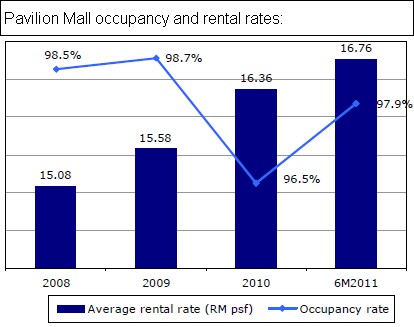
Since it commenced its operations in late 2007, occupancy has consistently stayed above 96%, with a 3-year CAGR of 4% in average rental rate. With such a short operating history, the mall has recorded 31m visits in 2010, comparable to Suria KLCC’s 40m footfalls. Over the longer term, Pavilion Mall is poised to enjoy higher number of visits as it will sit near to the upcoming MRT station, which is less than 300m away. The covered skybridge currently under construction that connects Pavilion Mall and KL Convention Centre which in turn adjoins Suria KLCC and the Petronas Twin Towers, will also pull in more shopper traffic between the two tourist spots.


The Pavilion Tower (NLA of 167k sqf) is an office tower connected to Pavilion Mall. It currently has an occupancy rate of 41.4% (expected to achieve 80% by year end), housing Malton roup, Mrail International, Clever Eagle and Aker Engineering (from 1st July). As the office tower only contributes about 2% to total rental income, coupled with the oversupply of office space in KL city centre, we are neutral on this commercial asset.

Future Growth Potential

Three other retail assets can potentially be injected in future for growth. PavREIT has been granted rights of first refusals (ROFR) by its sponsor and a 3rd party to purchase fahrenheit88, Pavilion Mall extension and an upcoming community mall in USJ Subang. These assets are estimated to have a combined value of about RM1.5-2bn. We believe the injection of assets will take 2-3 years, as only farenheit88 is still in the early stage of operation, and the other two malls will only be completed in three years’ time.


How to Value?

We benchmark PavREIT against KLCCP. Although KLCCP includes non-retail assets such as office towers and hotel apart from Suria KLCC, all these assets are of Grade A class. To reflect its prime status, we value PavREIT at a target yield of 5%, which is close to the average yield of 4.72% for KLCCP over the past 5 years (we gross up to exclude the impact of corporate tax – as REITs do not have corporate tax component). This translates to a fair value of RM1.14, based on our FY12 DPU estimate.

Source: RHB Research report