Friday, 1 April 2011

OSK Stock Picks for April 2011

After being hit by a few Black Swan events, markets rebounded in March with the KLCI ending 1Q in the black. Moving into 2Q, we still see some short term volatility but are confident of an eventual rally to close in on our year-end KLCI target of 1680 points. We advise investors BUY Big Caps on potential rebounds while focusing on the more defensive Small Caps given their superior performance over the past few months. The favorite sectors remain Banks, O&G, Property and Construction in the mid-to-short term while the longer term buys are Media and Healthcare. This strategy is reflected in our April top buys as well.


Timber the BIG winner...
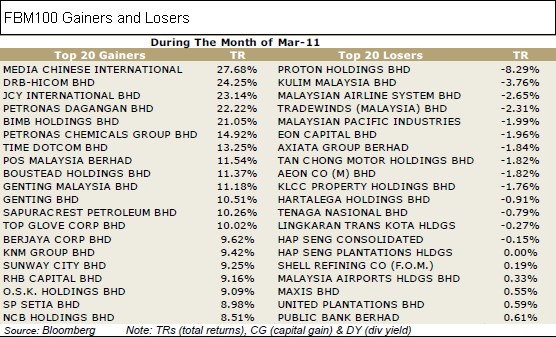
For March, timber stocks were actually the big winners, including names such as Suber Tiasa, Jaya Tiasa, TaAnn, WTK and Lingui, on hopes for better timber demand in view of reconstruction efforts in Japan. Nonetheless, these counters are not part of the FBM100. Instead, among the FBM100 constituents, media player Media Chinese and Petronas companies Petronas Dagangan and Chemicals were the big winners. Sectoral wise, O&G led the way followed by Technology (JCY), Media (MCIL), and Gaming (Genting).


Outlook: Moving into 2Q
Moving into 2Q, we see the possibility of some short-term volatility for the remainder of 2011 but market fundamentals remain sound. We maintain our year-end KLCI target of 1680 points based on an average of the 2011 KLCI fair value (1648 points 16x PER) and 2012 KLCI fair value (1710 points 15x PER). With this in mind, we maintain Overweight on the Malaysian market. Our view is driven by 4 key factors:
  • The economy will continue to grow
  • Upside and Downside are fairly equal
  • News flow ahead of the General Election remains very supportive
  • Earnings should match expectations


For April - A month of 2 Halves
We believe that there may well be 2 distinct halves in the month of April. The first half should be positive for the market, with the one of the key factors being the Invest Malaysia conference which will be held on 12 April. Among the announcements could be:
  • The disposal of Khazanah's stake in Pos Malaysia
  • The next Risk Service Contract for marginal oil fields
  • Release of Government lands for property development
However, for the second half of the month, we are concerned of greater market volatility, due to potentially less positive outcome of the Sarawak elections. Since BN already holding more than 80% of the state seats, we believe the risk is that their performance may drop in this upcoming election. Consequently, this may spark some knee jerk selling until the 1Q2011 reporting season.


Source: OSK Reseach Report

Wednesday, 30 March 2011

How US Housing Market fares lately? (30 March 2011)

Indeed, there is a insightful write-up by RHB Research today on the US housing market. People are still very curious about the US housing market, but yet to have the courage to BUY. Herd mentality? And, why US housing market is catching the attention of the world? Oh, thanks to Rich Dad Poor Dad, and the world famous property tycoon, Donald Trump.


In fact, I am wondering how did Donald fares these few years? That's why Donald had teamed up with Robert Kiyosaki to publish a book last year? People stop buying property because they're buying books nowadays?

A Double-Dip in the US Housing Market?... by RHB Research (30 March 2011)

US home prices, as measured by the S&P/Case-Shiller composite index of 20 metropolitan areas, declined by 0.2% mom in January vs -0.4% in December, and dipped for the 7th straight month to the lowest since April 2009. Year-on-year, home prices in 20 major cities fell by a larger magnitude of 3.1% in January, the 4th consecutive month of decline and from -2.4% in December. Home prices in these cities climbed up for 8 consecutive months from February until September 2010, before relapsing into a decline again since October last year, suggesting that the housing market is weakening, which will remain a drag to the economic recovery.

In many areas, home prices have fallen to 2003 levels, prior to the start of the housing bubble, due to the glut of supply in the housing market caused by rising foreclosures. This was compounded by potential house buyers' expectations of further drop in house prices, making them stay on the sidelines before entering the market to buy even cheaper houses. As a result, prices may fall further until foreclosures and short sales are cleared. Also, despite the millions of foreclosures and short sales, which is when lenders allow homeowners to sell for less than they owe on their mortgage, many of the homes for sale are undesirable, as the supply of homes that people actually want to purchase or could afford to is much narrower.


As a whole, falling prices and weak home sales would likely pose a drag to the economy, which is showing signs of strength elsewhere. Already, claims for unemployment benefits are at pre-recession lows, consumers are spending more money and manufacturing activity is growing at its fastest rate in 7 years. By contrast, sales of existing homes are coming off the worst year in more than a decade. And new homes are selling at the slowest pace on records dating back to 1963. In part, the weakening prices show how much a home-buying tax credit stimulated sales in late 2009 and early 2010. Once those tax credits expired in April 2010, many markets began a decline that shows no sign of stopping yet. Some economists say the tax credits merely postponed the bottoming out that's occurring now.

So, when would US Housing Market Recovers?
Finance Malaysia has a very general answer, abandoning all those complicated theories and analyst, that the US housing market will recovers once investors can't find any bargain at emerging markets. This year, Hong Kong is expecting a slowdown in property sales, with Li Ka Shing too looking to other vehicles for growth. China is going to increase interest rate again to curb excessive liquidity and inflation. Back home in Malaysia, BNM is hinting for more measures to control high household debt. Soon, investors would re-look and re-position themselves on US once emerging countries can't give them their desired return.

Wages and Inflation

Those who see no inflation in our future usually rest their argument on slow wage growth. The argument is that if wage rates don't increase, then there is nothing to pass on in the form of higher prices. Would that it were so?

The real issue is not whether wages are rising. The real issue is whether or not labor costs are rising. Wages are only one component of the cost of labor to business and wages represent a declining portion of that cost. Ask Walmart.

As Walmart faces a potential multi-billion lawsuit, companies around the US brace themselves for massive copy-cat employee lawsuits. All large companies now have to factor in dramatically higher potential liability costs associated with the Walmart lawsuit. Don't believe that companies aren't watching the developments in the Walmart case -- they are.

As for Walmart, you can be sure that they will make every effort, over time, to pass their litigation costs on to their labor force. But, in the short run, the cost of labor at Walmart has just risen dramatically, while wages have gone nowhere.

Lawyers are the big winners here. The losers are folks looking for a job or looking for a wage increase. Even if wages decline, there will be substantially higher labor costs ahead thanks to government efforts to "protect" employees. All of these protection mechanisms are costly and will be passed on to consumers in the form of higher prices.

The issue is not whether wages are rising. The issue is whether labor costs are rising. The answer is that labor costs are rising and rising at an incredible pace. Hence, higher prices.

Tuesday, 29 March 2011

Who would be the winner of POS Malaysia?

It's been awhile since the government announcing its intention to divest its shareholding in Pos Malaysia last year. Through Khazanah Holdings, the government owned 32% stake in Pos. Let's re-look at the news with updated info, and hopefully we can have a better prediction on Pos in the near term.


While waiting for a new strategic partner, Pos has declared a one-off final and special dividend of 17.5sen, which provides a dividend yield of 5.7%. However, OSK is maintaining its fair value for Pos at RM4.12 with a BUY call. It closed at RM3.32 yesterday.
On 29th March 2011, Business Times reported unconfirmed sources said that Khazanah had just shortlisted 3 out of 5 parties bidding for its 32% stake in Pos.

Who are they?
The 2 candidates that already failed are:
  1. Scomi Bhd
  2. Tricubes Bhd
The 3 still-in-run candidates are:
  1. Nationwide
  2. MPC-Amanah REIT
  3. DRB-Hicom
The shortlisted parties will make a final presentation today to Khazanah and McKinsey & Co, who is the adviser. Pos' book value per share stands at RM1.54 and it is known that 3 shortlisted candidates are bidding at between 2.2x and 3x. This implies an offer of RM3.38 - RM4.62 per share. It was reported that the ultimate winner will be announced by the Prime Minister during Invest Malaysia 2011 on 12th April (Tuesday).

What is in the offing from the 3 candidates?
Of the names, each has its own niche expertise, with one looking to inject a bank (likely Syed Mokhtar's Bank Muamalat), one with a logistics expertise (Nationwide) and the other a property developer (MPC and Amanah REIT). It was previously rumored that Syed Mokhtar (DRB) is offering RM1bn for Khazanah's divested stake, which works out to be RM5.78 per share. (OSK Research)

What is so exciting about Pos Malaysia?
  • Relaxation of Postal Act, which could allow Pos Malaysia to re-develop some of its land parcels to unlock the value of its land-bank.
  • Expanding revenue from offering shared banking services with RHB and Maybank.
  • Plans to introduce a new direct address mail service soon. Advertisers can channel some of their advertisement spending to direct address mail to target customers.
Recent DRBHCOM share price movement

Finance Malaysia's prediction...
While not able to access the inside information, Finance Malaysia looks at a different angle to predict the ultimate winner, this time via technical analysis. Judging from the past weeks price movements, DRB Hicom is signaling something boiling behind. Today, DRB closed at RM2.16. Would it be the one?

Monday, 28 March 2011

Inflation is Picking Up

While Bernanke continues to look in the rear view mirror hoping to spot some deflation, the facts on the ground and the road ahead are clearly all about rising inflation. The February CPI numbers released today, an annual rate of five percent should give Bernanke and his QE2 activity a reason to reflect. It is true that in a world of no food and no energy the numbers look better, but who lives in that world?

What are the implication of rising inflation? Trouble in bond land. This means investor losses on bonds and headwinds for stocks. Unanticipated inflation is always bad news for stocks. Inflation reduces the value of the national debt, but inflation increases the deficit, offsetting the former effect.

One big plus: the housing market will benefit from increasing inflation, mostly because homeowners are big debtors and have fantastic tax advantages compared to the owners of any other asset (even better than owning oil wells!). Those who buy homes now and over the next year or two will be big winners. Stocks will do fine longer term, bonds are headed for disaster, and homeowners will strike gold.

New Fund: HwangDBS Select Dividend Fund

To further leveraging on the signature "Select" series of HwangDBS funds, HwangDBS Investment Management Berhad today added in HwangDBS Select Dividend Fund. Over the years, the Select series of funds have demonstrated strong performance, stability and consistency in meeting their objectives. Through this new fund, investors can access a diversified, yet focused portfolio of quality dividend yielding stocks in Malaysia and Asia-Pacific region.


The fund endeavors to provide a combination of regular income and capital growth over the medium to long term period. To achieve the primary objective of providing regular income, the fund intends to invest in high dividend yielding equities and equities that could potentially experience high dividend pay out growth. The fund's investments will be primarily focused in Malaysian equities with a minimum investment of 70% of the fund's NAV. The fund may also invest up to 30% of its NAV in Asia-Pacific region.


Two-part Approach?
  1. Stable and High Dividend Yielding Equities
    • Invest in already well recognized, stable and high dividend yielding equities
    • Regular income
    • Stability
  2. The "next dividend leaders"?
    • Identify and invest in equities which have the potential to become strong, quality dividend paying equities in the future
    • Those that potentially to start a dividend payout policy
    • Those that potentially increasing current dividends payout levels
    • Dividend plus Capital appreciation
Income Distribution: Semi-Annually?
  • Targeting 8% to 10% returns per annum with moderate levels of risks
  • Semi-annual income distributions which give investors flexibility for cash flow needs plus potentially higher returns than Fixed Deposits or local Bonds

Source: HwangDBS Investment Management website

Click here to read the prospectus

Sunday, 27 March 2011

Cost Is Not The Real Issue

You hear the President criticized over the cost of the new Libyan military adventure. Whatever the merits or demerits of the President's new military activities, they are not really that costly. That's why they are so easy to do. The cost restraint for military adventurism is not really binding anymore. We could fight a number of wars all over the globe for a pittance of what it costs to support Medicare, Medicaid, Obamacare, and Social Security.

War is cheap! The volunteer army did that for us. It replaced conscripts with folks that really wanted to do this. So we have fewer of them, pay them better, and they do a better job. Plus, war technology has improved.

So, Obama gets a push-button war on the cheap. Whether it's a good idea or not is an entirely different story, but cost is not the issue.