The stock market has thundered forward since the turn of the year. Unemployment claims are near their twelve month low and even California thinks it sees balanced budgets ahead in their future. So, are we there yet?
Unfortunately, nothing has really changed. Let's begin with California. California, New York and Illinois face an almost immediate crisis with their pension systems. These problems are far, far larger in magnitude than their total annual spending budget for everything else they do. And, the clock is ticking. These problems don't get better every day; they get worse.
California, like New York and Illinois, believe that higher tax rates have no effect on economic behavior. They are wrong. Thus, the revenue projections these states are expecting from higher tax rates are an illusion. Even without pension funding issues, these states are on a straight line to some form of bankruptcy, even if the day of reckoning is not (yet) known with certainty. These states have done nothing to reign in excessive spending or face up to unfunded liabilities....nothing at all, much like their big sister -- the US government.
At the national level, the US remains mired in the slowest economy recovery in modern times. New and higher taxes that impact almost all Americans and almost all businesses (think income taxes, payroll taxes, Obamacare-imposed taxes and higher health insurance rates for almost everyone). These new taxes will slow any green shoots in the economy from gaining enough strength to power a real recovery. Expect continued stagnation, continued high unemployment.
What about Europe? Aren't things better there? There is certainly a pervading sense of euphoria that the worst is over. Is it? What has changed? Today, Europe has significantly more sovereign debt than it had two years ago. Today, the Eurozone is in a recession which it wasn't in two years ago. Today, the same stultifying labor laws and regulations maintain their stranglehold on European economies. No real change there.
Recall the fall of 2007. This was a time period a full year after the housing market had begun its collapse and after several large mortgage companies had gone bankrupt. This was a time three months after the asset-backed securities market (a market responsible for 20 percent of all debt financing in the US) had ceased to function.
What happened with all of these problems staring us in the face? The stock market surged to an all time high topping 14,000 in October, 2007. Lehman Brothers and Bear Stearns traded at their all time highs in a burst of euphoria that the worst was over. Five months later Bear Stearns collapsed and within twelve months Lehman Brothers failed in the climax of the financial collapse of 2008.
It is an interesting question why the stock market surged in late 2007 after it was widely known that the housing market was in full freefall and that housing finance was shaking the foundations of most of the larger banks. One wonders why European stocks are surging today in face of the facts on the ground. As for the US markets, is current market enthusiasm well founded or are we repeating the late 2007 scenario?
Friday, 25 January 2013

Tuesday, 22 January 2013
So Much for the National Debt
Obama's inauguration speech yesterday makes it pretty clear. He has no intention of discussing ways to lower the deficit and begin to tackle our national debt problems. Quite the reverse! Obama has more spending, taxing and regulating plans ahead for the next four years. As if the economy wasn't bad enough, Obama is planning more anti-capitalism moves.
You wonder if his advisers have any idea what the implications are for the economy of all of this. There was always the chance that a Republican House would block the most extreme measures, but that is becoming increasingly unlikely as Republicans tack feverishly in Obama's political direction.
Given Europe's situation, which is far, far worse than the pundits are saying, the economic outlook for the US is pretty bleak. The best that can be hoped for is more slow growth and stagnant employment. That is the very best that one can hope for! The worst is that the economy could begin to slip into recession mode. While pundits think Europe is doing better, the truth is that, compared to two years ago, the European economies are much, much weaker, the level of sovereign debt in Europe is much, much higher, and what little restraint on spending and regulation has lost its political support. Europe is doomed.
The real question is whether capitalism in the US is doomed as well. It may well be.
You wonder if his advisers have any idea what the implications are for the economy of all of this. There was always the chance that a Republican House would block the most extreme measures, but that is becoming increasingly unlikely as Republicans tack feverishly in Obama's political direction.
Given Europe's situation, which is far, far worse than the pundits are saying, the economic outlook for the US is pretty bleak. The best that can be hoped for is more slow growth and stagnant employment. That is the very best that one can hope for! The worst is that the economy could begin to slip into recession mode. While pundits think Europe is doing better, the truth is that, compared to two years ago, the European economies are much, much weaker, the level of sovereign debt in Europe is much, much higher, and what little restraint on spending and regulation has lost its political support. Europe is doomed.
The real question is whether capitalism in the US is doomed as well. It may well be.
Monday, 21 January 2013
CLSA Malaysia Politics Market Strategy
There is no better time to blog about this post. After the plunge of KLCI yesterday, citing election risk, we came across an interesting research report by CLSA. As such, we would like to take this opportunity to share with you.

By CLSA,
An unexpected opposition Pakatan Rakyat (PR) coalition victory in the impending 13th General Election (13GE) would spark a broad sell-off in Ringgit assets. Changes of government are not uncommon in ASEAN. Looking at the experience of Indonesia, Thailand and the Philippines over the last decade, parliamentary control has seen significant shifts and governance has been possible despite the lack of a parliamentary majority. However, Malaysia has never experienced a change in government, meaning any change will come as a shock and with a host of uncertainties.

From an equity and debt market perspective, Malaysia has always enjoyed a political premium for the stability in governance and policy-setting stemming from majority control of parliament. The immediate financial market repercussions can be grouped as follows:
- Equity and bond markets sell-offs are likely as Malaysia's political stability premium is erased, at least temporarily. Domestic corporate, many of which have deep links with the existing government, will be putting big-ticket decisions on hold pending guidance on continuity;
- Ringgit depreciation can be expected in parallel with the sell-off in Malaysian assets by foreign investors. This will pose another drag on broad corporate and foreign investor confidence, especially foreign debt (though positive impact on exporters should not be forgotten).
- And, subsequently draw unfavorable attention from international rating agencies.

Near-term policy expectations
- PR's stated policies are broadly aimed at raising disposable incomes, improving fiscal governance (key revenue generator), and encouraging private investment.
- Higher minimum wage and lower car prices will support consumer spending, while cutting ASEAN-topping corporate tax rate would reassure corporate and investors.
- State oil company Petronas will get more resources to invest in rebuilding reserves.
Medium-long term policy focus
- PR's desire to "rebalance" government contracts and agreements means negative overhangs for state-dependent entities i.e. utilities, concessionaires, construction.
- Banks as large holders of private sector bonds will face negative risk perception.
- Reversing GLC dominance (Iskandar not impacted) will boost private investment and FDI; Khazanah could accelerate local asset disposals, lifting Bursa's free-float.

"Rain or Shine" stock picks
- At the macro level, companies with government-dependent contracts, licenses and concessions will see sustained negative overhang and discounting, while consumer and oil & gas sectors will benefit from rising disposable income and Petronas capex.
- Our "rain or shine" stock picks are expected to do well under either a BN or PR-led government, with earnings underpinned by higher disposable incomes, Petronas association, overseas earnings contribution buffer and a weaker currency.
- A market sell-off would be a prime opportunity to add to positions in Axiata, PGas, UEM Land, IHH, Sapura Kencana, AirAsia and exporters e.g. rubber glove players.

Source: CLSA Asia-Pacific
Saturday, 19 January 2013
Republicans Go Over the Cliff
Too often, Democrats get blamed for our national debt problems and the economic stagnation that has come to characterize the US economy. Republicans deserve their share of the blame.
Who provided the votes necessary to escape considering our debt problems at the start of this year? Speaker Boehner violated the "Hastert Rule" and let the Senate bill come up for a vote which raised taxes. 48 Republicans then voted for the bill. A solid victory for Obama. A solid defeat for the American taxpayer. And, who engineered this? Republicans. Ditto for the emergency pork bill that passed the House last week. Once again, with Boehner's concurrence, Republicans provided the necessary votes to pass this abomination as well.
Yesterday, Republicans announced unilateral pre-emptory capitulation before the White House by pledging to extend the debt ceiling for three months in exchange for the usual -- nothing.
What is the difference between a Republican majority in the House of Representatives and a Democrat majority? The answer -- nothing at all.
You get the same legislation, the same bad economic policy. There is absolutely no difference.
Republicans object that the polls show that the public is on Obama's side. What did the polls show, then and now, about Obamacare as Obama jammed his unpopular health care through the Congress? It showed that Obamacare was unpopular then and unpopular now. But, did that matter? No
Obama saw it through. Say what you will. The Democrats believe in what they are pushing. The Republicans don't and it shows. Small wonder that Republicans have trouble getting their voters to the polls. Why bother?
Who provided the votes necessary to escape considering our debt problems at the start of this year? Speaker Boehner violated the "Hastert Rule" and let the Senate bill come up for a vote which raised taxes. 48 Republicans then voted for the bill. A solid victory for Obama. A solid defeat for the American taxpayer. And, who engineered this? Republicans. Ditto for the emergency pork bill that passed the House last week. Once again, with Boehner's concurrence, Republicans provided the necessary votes to pass this abomination as well.
Yesterday, Republicans announced unilateral pre-emptory capitulation before the White House by pledging to extend the debt ceiling for three months in exchange for the usual -- nothing.
What is the difference between a Republican majority in the House of Representatives and a Democrat majority? The answer -- nothing at all.
You get the same legislation, the same bad economic policy. There is absolutely no difference.
Republicans object that the polls show that the public is on Obama's side. What did the polls show, then and now, about Obamacare as Obama jammed his unpopular health care through the Congress? It showed that Obamacare was unpopular then and unpopular now. But, did that matter? No
Obama saw it through. Say what you will. The Democrats believe in what they are pushing. The Republicans don't and it shows. Small wonder that Republicans have trouble getting their voters to the polls. Why bother?
Who Are The Supercar Owners?
 |
| KPO Cafe Bar |
Whenever I walk past the 'KPO Cafe Bar' situated beside Orchard Central, the fleet of supercars parked outside the bar never fails to impress me. I have seen cars like Audi R8, Lamborghini Aventador, Ferrari 458 Italia, Nissan GTR, BMW M3, Maserati GranTurismo and different models of Porsche, BMW, Mercedes, etc parked outside the bar. It subsequently piqued my curiosity on who are the people who own them and I started stealing glances of the customers drinking inside the bar and on the open air balcony.
Here are some of my observations:
- People dressed in their business attire can be seen drinking at the bar as early as 4-5pm
- About 30 to 50% of the customers are Caucasians
- Majority of them are in their early 30s to mid 40s
A first hand GTR already costs $350,000 including COE. Monthly maintenance is probably more than $4,000 including petrol, road tax, car insurance, ERP, etc. And we're only talking about a GTR which costs $350,000 here. What about an Audi R8 Spyder which costs twice as much? So who are these supercar owners? What do they do? How can they afford a supercar?
I feel that there are only a few possibilities:
- They are successful executives (lawyers, surgeons, bankers, etc)
- They are successful business owners or 2nd generation business owners
- Supercar belongs to father/family
- They are overleveraged
However, from my personal experience, not every wealthy person owns a supercar. For example, the owner of a venture capital firm that I interned at drives a humble Toyota Camry despite having a personal net worth of more than $30 million. The father of my good friend who earns more than a million dollars a year and stays in a Good Class Bungalow owns a Audi A4 and a Volvo S80.
Living in a country with the world's highest concentration of millionaires and the largest proportion of wealthy expatriates where 54% of them earns US$200,000 or more, I will have to work harder, save harder and invest smarter.
Friday, 18 January 2013
The New Wall Street
Better-than-expected results were common for the major money-center banks that reported earnings this week. The announcement of these "good results" were accompanied by more layoff notices from every large bank. Wall Street continues to downsize as the rest of the economy remains in hunker-down mode.
We are gradually becoming accustomed to accepting economic stagnation as the new normal. Reminiscent of the 1970s, Americans are becoming used to sluggish job prospects, sluggish income and wealth growth, and massive and continuing unemployment. All of this is now described, by the president's coterie of supporters in the media, as an improving economy. This is not an improving economy so much as a different economy.
The place to be is somewhere in the government or quasi-government sector. You can make high six figure incomes at a relaxed pace in the upper echelons of most large universities. Even better, you probably aren't at risk of being laid off. But, if your plan is to enter the private sector and work your way up, the historic pathway of the American dream, you can probably forget it.
Working for government, at any level, is the ticket. Once an economy reaches the degree of government control and government ownership that the American economy has reached, the pathway to success changes. You can't depend upon the vibrancy of the economy any longer. That vibrancy has been legislated out of existence. So heading off to the private sector is problematic. Instead, it is time to strap on your politics and find your way into a government job or a non-profit job or a job in the educational sector. That is the pathway to success in the new economy.
Of course, this means increasingly that economic growth will not happen. How can it, when most people that "work" aren't involved in producing anything. Many so-called "workers" are mainly enforcing laws that prohibit others from working. If you have an economy where a growing percentage of workers produce laws and regulations and then enforce them, while a dwindling few produce anything of substance, then the real pie can't grow.
Instead you create a national divide -- something we can already see emerging -- between those in the protected sectors of government, education, and non-profit (funded by tax-reducing so-called charitable donations) who have incomes and job security and those fending for their life in the increasingly marginalized private sector.
So, the new Wall Street is simply the most visible current display of the decline of American economic leadership. The Obama plan is working.
We are gradually becoming accustomed to accepting economic stagnation as the new normal. Reminiscent of the 1970s, Americans are becoming used to sluggish job prospects, sluggish income and wealth growth, and massive and continuing unemployment. All of this is now described, by the president's coterie of supporters in the media, as an improving economy. This is not an improving economy so much as a different economy.
The place to be is somewhere in the government or quasi-government sector. You can make high six figure incomes at a relaxed pace in the upper echelons of most large universities. Even better, you probably aren't at risk of being laid off. But, if your plan is to enter the private sector and work your way up, the historic pathway of the American dream, you can probably forget it.
Working for government, at any level, is the ticket. Once an economy reaches the degree of government control and government ownership that the American economy has reached, the pathway to success changes. You can't depend upon the vibrancy of the economy any longer. That vibrancy has been legislated out of existence. So heading off to the private sector is problematic. Instead, it is time to strap on your politics and find your way into a government job or a non-profit job or a job in the educational sector. That is the pathway to success in the new economy.
Of course, this means increasingly that economic growth will not happen. How can it, when most people that "work" aren't involved in producing anything. Many so-called "workers" are mainly enforcing laws that prohibit others from working. If you have an economy where a growing percentage of workers produce laws and regulations and then enforce them, while a dwindling few produce anything of substance, then the real pie can't grow.
Instead you create a national divide -- something we can already see emerging -- between those in the protected sectors of government, education, and non-profit (funded by tax-reducing so-called charitable donations) who have incomes and job security and those fending for their life in the increasingly marginalized private sector.
So, the new Wall Street is simply the most visible current display of the decline of American economic leadership. The Obama plan is working.
Wednesday, 16 January 2013
TA 2013 Malaysia Outlook: Ride the Volatility
By TA Securities,
We believe 1H13 will be a choppy period and election concerns could drag down the FBM KLCI by 8% to 10% in the period before market rebounds in the 2H13. The impetus for revival will mainly hinge on the end of election overhang and strong domestic demand.

Sustained monetary easing on the back of low inflationary pressure and attempts to reduce budget deficits by cutting subsidies and channeling the savings to productive ventures are positive despite the short-term impact on earnings. Overall, domestic economy will play an integral role in sustaining confidence in domestic equities next year in the absence of any overwhelming micro drivers.

Corporate earnings for 9M12 were less robust and we forecast full year earnings growth for the FBM KLCI to be 9.4% only. Chances of a strong revival in the immediate-term are minimal based on external sentiment and dwindling demand in key export markets. Our earnings growth forecast of 8% and 8.4% for CY13 and CY14 is not compelling vis-a-vis key regional emerging market's 16.1% and 14.7% respectively. It could come under further pressure if the implementation of minimum wages had greater impact in raising the input cost than the intended increase in disposable income and spending. High likelihood of subsidy cuts (electricity tariff and fuel price increases) post 13th General Election would be negative on earnings and will prompt us to trim our CY13 and CY14 forecasts by 1.2% and 4.9% respectively.


How about Foreign Markets?
External factors will continue to dictate the market directions. The structural flaws cannot be undone overnight but expect bouts of positive improvements to kick in the 2H13 as fats are trimmed and jobs created. China could revive its domestic growth without stoking inflationary pressure but it can be destabilizing factor if its row with Japan escalates. The same applies to Iran and the West.
Can KLCI end Strong this year?
We derived our end-2013 target of 1,710 for FBM KLCI after applying 2008-2011 average forward PER of 14.3x on mid-cycle EPF of 120 sen. The underlying key assumption is that BN will return to power with slim majority. This target is a 5% discount to our bottom-up valuation of 1,800.
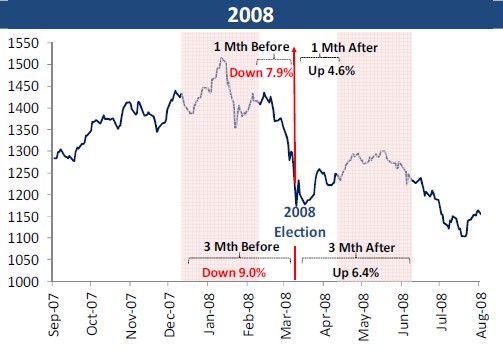 |
| FBM KLCI performance before and after 2008 Malaysia's election |
Strategy...
Sell-on-strength, especially overvalued defensive plays in the Consumer, Healthcare and Telco sectors and turn cash-heavy to accumulate high beta plays in domestic sectors, which are mainly related to Construction, Oil & Gas and Property sectors, in 1H13. Banking sector holds good buys based on their attractive valuation, still robust loan growth and bright chances of benefiting from ongoing domestic expansions.

Source: TA securities report
Subscribe to:
Posts (Atom)